







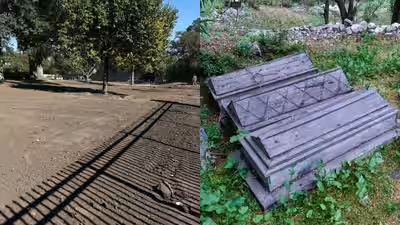
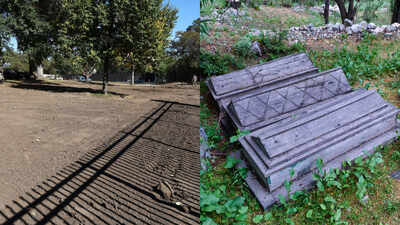
A routine security upgrade at North Dakota’s governor’s residence has opened an unexpected window into Bismarck’s past. What began as a $2.35 million project to improve fencing and access around the property turned into an archaeological investigation after construction crews uncovered human remains beneath the ground, states an online report by North Dakota Monitor. Months later, archaeologists have removed seven coffins containing human remains, along with an unidentified wooden box, after examining more than 80 areas of interest around the construction site, the report adds.
A cemetery beneath modern Bismarck
The discovery dates back to May, when workers installing a new fence near the governor’s residence encountered human remains. The location was once part of Bismarck’s first cemetery, which operated between 1873 and 1877. Many of the people originally buried there were later moved to St. Mary’s Cemetery and Fairview Cemetery during the 1880s. The discovery suggests that some burials may have remained behind despite those historic efforts to relocate graves, the report adds.Archaeologists returned to the area in September for a more extensive investigation. Their work covered more than 80 areas identified as potentially significant, eventually leading to the removal of the seven coffins and the wooden box. The findings add another layer to the history of a part of the city that has undergone substantial development since the cemetery was active, adds the report.
A careful examination of the remains
The archaeological work is now moving into its next phase. Researchers will examine and catalogue the remains and other objects recovered during the fieldwork, a process expected to continue into early 2027. The analysis is expected to focus on basic biological information such as estimated age ranges and possible evidence of disease or other conditions that might provide clues to the individuals buried there.DNA testing is not planned as part of the investigation. Instead, archaeologists will rely on physical examination and historical research to better understand the remains and the circumstances surrounding the burials. The unidentified wooden box recovered alongside the coffins will also be examined as researchers work to establish a clearer picture of what was once located on the site.
Not the first discovery in the area
Human remains have been uncovered elsewhere around the North Dakota Capitol grounds over the decades, claims the online report. Previous discoveries occurred during construction of a trolley line near the southwest corner of the Capitol property in 1903. Remains were also found in 1959 while the previous governor’s residence was being constructed. The latest discovery therefore forms part of a longer archaeological story beneath the modern government complex, where layers of Bismarck’s early history remain hidden below later development.
Preparing for a respectful reburial
Authorities are taking steps to ensure the recovered remains are handled appropriately. The state has contracted with a local funeral home, while Crisis Care Chaplaincy has offered support during the process. Once the archaeological examination is complete, the remains are expected to be reinterred at a local cemetery in spring, adds the report.The reburial will provide a final resting place for people whose original graves were effectively lost beneath the changing landscape of the city.
An unexpected cost to a security project
The archaeological discovery has also added an unforeseen expense to the governor’s residence project. Lawmakers approved $2.35 million last year for security improvements, including a new perimeter fence and an extension to the driveway.By September 1, archaeological work associated with the discovery was estimated to have cost the state an additional $155,000. The Office of Management and Budget has not yet provided an updated figure following completion of the exhumation work.Images Courtesy: istock and North Dakota Monitor