









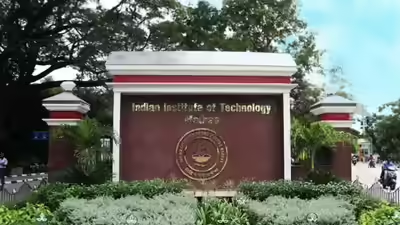
MUMBAI: Cybersecurity is moving from the margins of computer science classrooms to the centre of India’s higher education agenda.The Indian Institute of Technology (IIT) Madras and IIT Kanpur have jointly launched what they describe as India’s first practice-oriented, four-year Bachelor of Cybersecurity programme.The B. Cyber course will begin in the academic year starting July 2026, with admissions being conducted jointly by the two IITs this year.The programme has been designed to meet India’s rising demand for cybersecurity professionals at a time when digital systems increasingly underpin governance, finance, healthcare, telecom, transport, manufacturing and defence.Officials said the course will train students not merely in the theory of cybersecurity, but in the operational skills required to protect complex digital infrastructure and critical systems.Graduates are expected to be prepared for roles in cyber defence, security operations centres, penetration testing, vulnerability assessment, digital forensics, malware analysis, cloud security, hardware security and critical infrastructure protection.The programme will also provide a foundation for higher studies and research in cybersecurity and computer science.“Cybersecurity has become fundamental to India’s technological sovereignty and national security,” said Prof V Kamakoti, director, IIT Madras. “Building a resilient cyber ecosystem requires professionals who possess not only strong theoretical foundations but also extensive hands-on experience in defending complex systems.”He said the collaboration with IIT Kanpur marked a new model of undergraduate education, combining academic rigour with real-world practice.“We believe this initiative will create a pipeline of highly skilled cybersecurity professionals who will play a vital role in securing the nation’s digital future,” Kamakoti said.The launch comes at a time when cybersecurity has emerged as a strategic national priority. As India’s digital footprint expands, the need to protect public platforms, financial networks, healthcare systems, telecom grids, industrial infrastructure and defence-linked technologies has grown sharply.Industry estimates point to a shortage of nearly 1.5 million cybersecurity professionals in the country, underlining the need for specialised undergraduate training in the field.A defining feature of the new degree is its two-year Field Deployment Professional Project. Students will spend the final four semesters working on live cybersecurity projects under the mentorship of professionals from strategic and critical organisations.The idea, officials said, is to ensure that graduates enter the workforce with substantial field exposure in addition to formal academic training.The curriculum follows a competency-based framework, allowing students to progressively build expertise across domains such as security operations, vulnerability assessment and penetration testing, secure systems, malware analysis, firmware reverse engineering, hardware security, cloud security and critical infrastructure security.
Do you believe the new B. Cyber program will effectively address the shortage of cybersecurity professionals in India?
3k+ users shared opinion today
5k+ users already voted today
3k+ users shared opinion today
Students will also be able to choose advanced electives in digital forensics, embedded systems security, secure processor microarchitecture and applied cryptography.The first two years of the programme will focus heavily on laboratory-oriented instruction. Students will study computer systems, programming, Linux system administration, cryptography, computer organisation, operating systems, computer networks, ethical hacking, web security, vulnerability assessment and penetration testing before moving into advanced specialisation and professional deployment.For the IITs, the programme signals a shift in how cybersecurity education is being imagined: not as a late-stage specialisation, but as a full undergraduate discipline built around labs, live systems and field practice.