










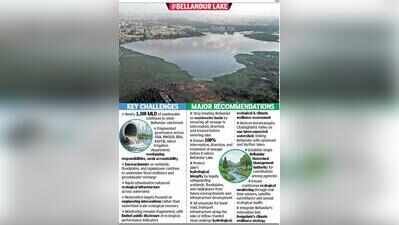
Bengaluru: Nearly a decade after Bellandur Lake grabbed national attention for spewing toxic foam and catching fire, new research has found that the lake remains ecologically degraded because the Rs 179-crore restoration efforts have largely focused on engineering interventions while not adequately looking into its hydrology and ecological processes.‘Saving Bellandur Lake,’ a report by residents’ group Kempapura-Yemalur Bellandur Institution Association, draws on field investigations by residents as well as Indian Institute of Science (IISc) studies.It notes that successive restoration efforts have largely centred on desilting, sewage diversion, aeration, floating wetlands, bioremediation, weed removal, and shoreline clean-up. “While these measures have helped reduce visible problems such as frothing and odour in certain stretches, they have failed to restore the lake’s ecological functioning because they address the symptoms rather than the root causes of degradation,” it states.According to the study, Bellandur’s restoration has largely neglected wetlands, floodplains, rajakaluves, biodiversity, and the natural hydrological flows that historically sustained the Bellandur-Varthur watershed.Reiterating recommendations made by IISc and the Mahendra Jain Committee, the report states Bellandur cannot be revived through isolated engineering interventions alone.Fragmented responsibilities among agencies such as Greater Bengaluru Authority, Bangalore Water Supply and Sewerage Board, Bangalore Development Authority, and minor irrigation department, coupled with land disputes, encroachments, tender delays, contractor-related issues, and weak inter-agency coordination, have slowed down implementation of restoration projects. Environmental groups cited in the report have pointed to the absence of clearly defined ecological recovery benchmarks, making it difficult to objectively assess the effectiveness of restoration measures.The study notes that untreated sewage inflows, recurring nutrient loading, and poor catchment management continue to undermine restoration despite significant investments in sewage treatment infrastructure.“Bellandur continues to receive untreated wastewater during periods of peak flow, while several rajakaluves remain partially blocked and hydrological connectivity across the catchment has not been fully restored. As a result, despite intermittent reductions in frothing, water quality remains poor because of untreated sewage, nutrient loading, and polluted urban runoff,” it states, adding that ecological recovery remains incomplete.The report calls for strict implementation of National Green Tribunal (NGT) directions. Over medium and long terms, it advocates decentralised wastewater treatment, catchment-wide wetland restoration, independent ecological audits, and the creation of a Bengaluru Urban Water and Wetland Authority to oversee integrated management of the city’s interconnected lake systems.