









By: Manjari Mishra“An amount of Rs 30,000 for household chores? Are you kidding me?”The news that the Supreme Court has assigned a monetary value to unpaid domestic labour comes as a genuine shocker to Brijrani.“Why? It would take me an entire afternoon to even count that much,” she giggles, eyes twinkling merrily.But the laughter dies quickly.

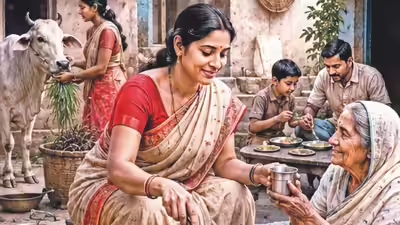
“How will my husband manage to shell out that sum every month? “And what if the judge ‘saab’ orders his arrest for unpaid dues,” she asks.When informed that the amount is merely notional — and posthumous — relief washes over the 26-year-old housewife from Rankauli block in Nandgaon, who is as easily assuaged as aroused.One among millions of newly designated “nation builders”, estimated by the Supreme Court to contribute 15-17% to India’s GDP through unpaid labour, she shall take some time — if ever — to get used to the pedestal.The apex court’s eulogy to this unsung and invisible tribe — the force behind “politicians, entrepreneurs, artists” and other heavy hitters — only bewilders her.“I never looked at myself that way,” she says in wonder.Perhaps it is time she should. As should her 160 million sisters.Rani’s day starts at 4am sharp.First comes feeding green fodder into the chaff cutter, slicing and mixing it into troughs, sweeping the cow pen, cleaning watering pails and setting them before the livestock.By then the menfolk are awake and waiting for their morning cuppa.“Gas stove?” she laughs at the question. “We are a family of 13. Even four cylinders won’t do. So, it is the earthen ‘chulha’, chopped logs and dung cakes.”“Oh, it fires up sooner than you city folks imagine,” she assures before dashing back into the pen to milk the cows. Then follows 40 minutes of frying ‘parathas’ — the family staple.Why her? Where are the other women? “You can’t expect an 80-year-old to slog in the kitchen,” she retorts archly. “And the ‘deorani’ had an operation last week. Poor girl, she is in so much pain.”“Men in the kitchen?” The young lady dissolves her into peels of laughter till her eyes water.“Am I dead or what? I would drown in a palmful of water — and so would my parents — if the old gentleman or any of his three sons was ever spotted stirring a pot.”Then, more thoughtfully, she says: “I can’t do what they do, and they can’t do what I’m good at. Only the monkey handler knows how to make the simian dance.”Simple logic. Potent enough to disarm the fiercest feminist.Then comes tending to the paraplegic mother-in-law — massaging, sponging, cleaning, changing and feeding.“She was once fair as milk froth and strong as a man before paralysis struck her. Now she is like a baby — so helpless.”Her voice softens. “May she live till a hundred. A household under the shadow of elders is truly blessed,” she says, folding her hands before the framed calendar of goddesses nailed to the wall.Indian women put in nearly six hours a day in unpaid work, according to OECD estimates. By 10am, Brijbala has already clocked that — and has another six hours stretched before. She would make it to the appraisal sheet all right — comfortably at the top of the regularly exceeds expectations column.Unpaid domestic labour totals an estimated $10.8 trillion globally, according to Oxfam.The Supreme Court has gone a step further and added to the list homemaker’s role as emotional anchor, manager and family’s backbone — shaping lives and destinies quietly, like a potter at the wheel. Brijrani is overwhelmed.“Never thought of dying. But good to know that even in death I could still be of some value to my family,” she muses.Try translating that sentiment into Indian currency.(Writer is a senior journalist. Views are personal)