









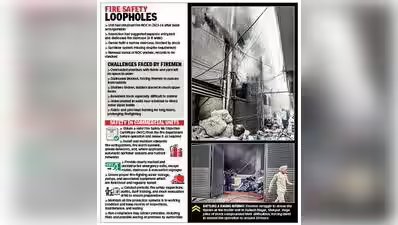
Ludhiana: It took seven fire tenders making around 200 rounds to douse a massive fire that broke out in a textile unit at Kailash Nagar in Sherpur late on Wednesday night.The struggle to control the conflagration went on for nearly 19 hours. Flames spread through the entire unit, destroying the huge stock of raw material and fabric stored inside.Officials said the fire started around midnight and quickly spread through the packed premises. The sheer volume of fabric and yarn posed the biggest challenge, leaving no space for firemen to enter and control the blaze from inside. “The unit was packed with stock, making it impossible to reach the fire directly,” one officer explained.The first tender from Focal Point station reached the site soon after midnight, but the intensity of the flames prompted immediate calls for back-up. Reinforcements from other stations arrived, and seven tenders were stationed at the spot.Thick black smoke covered the skyline and the basement fire proved especially difficult to contain. A fireman recalled, “When we reached, flames were visible across the unit. The owner told us the fire began on the upper floors. Some workers were inside at the time, but they managed to escape.”With staircases blocked by stock, fire fighters had to operate from outside. Ladders were placed against the building, shutters were broken open, and water pipes were directed at the upper floors. To tackle the basement blaze, holes were created in the walls near windows, allowing pipes to reach the flames.Sub-fire officer Aatish Rai said around 30 personnel were deployed in the operation. “The owner claimed the fire was triggered by a short circuit, but the exact cause cannot be confirmed yet. Fabric and yarn burn for a long time, which made the situation harder to control,” he said.Sources revealed that the unit had obtained a fire NOC from the department in 2023–24 after making basic safety arrangements. During the inspection, officials recommended several measures, including separate entry and exit points, fixed stock storage, and a dedicated four‑foot‑wide fire staircase connecting all floors. However, the staircase built by the owner was narrow, leaving room for only one person at a time. Moreover, it was blocked by stock. Officials also noted the absence of a sprinkler system, which was required under safety norms.The renewal status of the NOC remains unclear, with officials saying records need to be checked. “We had suggested specific safety measures, but compliance appears weak,” a source said.Though no casualties were reported, the incident has raised serious questions about fire preparedness in industrial units. The extensive damage to the factory and the prolonged firefighting effort highlight the risks posed by overloaded premises and inadequate safety infrastructure. Officials said a detailed probe will follow once the firefighting operation is fully concluded.Safety Loopholes–Unit had obtained fire NOC in 2023–24 after basic arrangements–Inspection had suggested separate entry/exit and dedicated fire staircase (4 ft wide)–Owner built a narrow staircase, blocked by stock–Sprinkler system missing despite requirement–Renewal status of NOC unclear, records to be checkedChallenges Faced by Firemen–Overloaded premises with fabric and yarn left no space to enter–Staircases blocked, forcing firemen to operate from outside–Shutters broken, ladders placed to reach upper floors–Basement blaze especially difficult to control–Holes created in walls near windows to direct water pipes inside–Fabric and yarn kept burning for long hours, prolonging firefightingFire safety in commercial units–Obtain a valid Fire Safety No Objection Certificate (NOC) from the fire department before operation and renew it as required–Install and maintain adequate fire extinguishers, fire alarm systems, smoke detectors, and, where applicable, automatic sprinkler systems and hydrant networks–Provide clearly marked and unobstructed emergency exits, escape routes, staircases, and evacuation signages–Ensure proper fire-fighting water storage, pumps, and associated equipment which are functional and regularly tested–Conduct periodic fire safety inspections, audits, staff training, and mock evacuation drills to ensure preparedness–Maintain all fire protection systems is in working condition and keep records of inspections, maintenance, and testing–Non-compliance may attract penalties, including fines and possible sealing of premises by authorities