









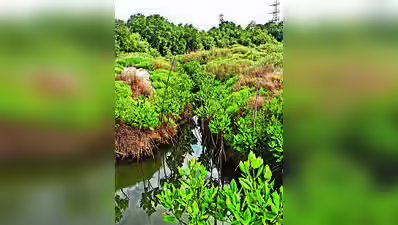
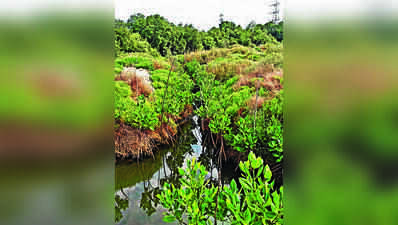
Against the backdrop of one of Tamil Nadu’s most industrially battered coastlines, forest officials have pulled off what they believe is an environmental triumph — in the Ennore Creek area of Tiruvallur district, mangrove saplings are now standing tall as natural bio-shields.An achievement given that the soil beneath has spent decades absorbing fly ash, industrial effluents and contaminated drainage water from the Buckingham Canal.The success story began three years ago with the setting up of a nursery exclusively for this purpose in Kattuppalli village, Tiruvallur district. Forest officials chose to raise five mangrove species suited to the region: Avicennia marina (venkandal), Rhizophora mucronata (kandal), Excoecaria agallocha (thillai), Bruguiera cylindrica (kaakandal) and Ceriops decandra (siru kandal).Being slow-growing by nature, the saplings needed nine months of careful tending before they grew three feet. In all, 1.6 lakh saplings were raised in the nursery and subsequently transplanted during the rainy season to give them the best chance of survival.“They now serve as a living defence against tsunamis, storms, cyclones and hurricanes,” says I Anwardeen, principal chief conservator of forests, research and education. “With vandalism and grazing kept in check, the saplings were allowed to grow undisturbed into a functioning coastal ecosystem. We have had an 80% success rate.”Before the first sapling was planted, the Tiruvallur forest department enlisted the expertise of J Murali, founder of Innovotek, to identify suitable planting locations and conduct soil and water quality tests.Murali, who has guided forest departments across Tamil Nadu from Tiruvallur down to Kanyakumari, says the Ennore-Manali belt presents a concentration of pollution sources unmatched anywhere else in the state.“Petrochemical industries, thermal power plants and automobile component manufacturers operate in close proximity, generating high pollution loads year-round. Decades of fly ash dumping have further degraded the soil, compounding an already difficult environment for any vegetation to survive.”Murali’s team mapped planting zones and monitored early growth to ensure eco-restoration took hold.“Mangroves have flourished at every other site my team has worked on, along the banks of the Cooum and Adyar rivers, and at Pichavaram in Cuddalore, but those locations carry far lower pollution loads than Ennore,” says Murali. “The fact that the mangroves have taken root here is proof that ecological recovery, even in the most compromised conditions, remains possible with science and persistence.”