









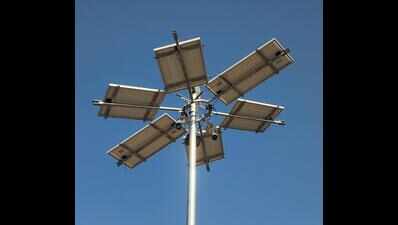
Ahmedabad: The Gujarat forest department moved swiftly to remove the newly installed floodlights from Nalsarovar sanctuary, soon after a TOI report flagged concerns that the lighting could harm the wetland’s bird population.On Thursday, TOI published a news report, ‘Too bright for birds? Floodlights at Nalsarovar spark fears for wildlife’. The report highlighted that the department had begun installing floodlights within the sanctuary as an anti-poaching measure.The move raised concerns among conservationists and ornithologists, who feared that the artificial light would disturb bird behaviour and discourage migratory species from visiting. Environmentalists and bird guides working at the site reported shifts in bird activity and feared the floodlights could disrupt the behaviour of birds that depend on Nalsarovar during winter.Soon after the concerns were published, forest department teams swung into action. They arrived at the site with cranes and removed the floodlights that had been erected along a circular route within the sanctuary. Plans to install seven more poles have also been shelved.Jaipal Singh, principal chief conservator of forests, confirmed the decision. “All the lights have been dismantled. Only one is left per pole, and that too solely to facilitate CCTV recording of poaching incidents.”The department had initially installed three solar-powered lighting towers as part of efforts to strengthen anti-poaching surveillance in areas where patrolling is difficult. Each pole carried seven high-intensity LED floodlights designed to illuminate large stretches of the wetland through the night.Conservationists argued that the plan ran counter to the basic purpose of a bird sanctuary, warning that it could disturb feeding, resting and roosting patterns, disrupt birds’ circadian rhythms, alter migration patterns, and raise stress levels among birds.Nalsarovar, a Ramsar-designated wetland of international importance, draws thousands of migratory birds each winter. A wildlife expert familiar with the department’s operations questioned why floodlights were used at all. “Night-vision cameras, already deployed successfully in Gir and various tiger reserves, could have served the same surveillance purpose without lighting up sensitive bird habitat,” he said.