








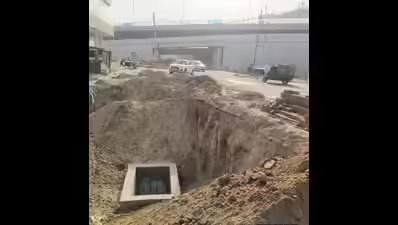
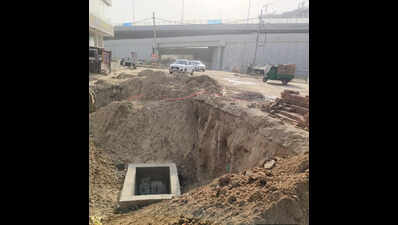
Gurgaon: MCG’s engineering wing, by its alleged negligence, has turned a crucial link road connecting Dwarka Expressway to Sarai Alawardi into an accident hotspot, culminating in a serious crash on Sunday. Residents are demanding accountability after the crash that left a motorist hospitalised.At the centre of the controversy is a 20-foot-deep pit dug for the connection of sewer infrastructure linking wards 34 and 6 to the 20 MLD Jahajgarh sewage treatment plant (STP). Residents said that after laying a 600mm main sewer line along the route, officials failed to construct the required main chamber (manhole), forcing the site to be dug up again and leaving critical work incomplete for months. However, MCG officials claimed that the work is nearing completion and will be over this week.The result is a gaping, life-threatening excavation sitting alongside a busy road with virtually no barricading, warning signs, reflectors or safety measures. RWA president of New Colony (Sarai Alawardi) Balwan Singh said, “This 20 ft deep pit has been dug up for the last four months and there is no safety barricading and the work is being done at a slow pace. This work of connecting the STP network of wards 34 and 6 to Jahajgarh started in June-July last year. However, it’s still incomplete. It has become a death trap for the residents.” The lack of streetlights on the road makes the situation worse, leaving the residents to navigate this road with only the vehicle’s light, Singh added.“There are no barricades, no warning lights and no safety arrangements. Anyone unfamiliar with the road can fall straight into the pit,” said Sunil Yadav, another resident.When questioned about the lack of barricading at the site, MCG executive engineer Sunder Sheoran said, “We are going to issue a notice to the contractor seeking explanation on why no safety measures, including barricading, are implemented at the site. The contractor will be asked to submit a report and barricade the area. The work to connect wards 34 and 6 with Jahajgarh STP is complete. However, a colony’s (A 85 colony) connection was left, which is currently being done. This work will be completed in a week’s time.”At the site to connect the sewerage network, multiple pits have been dug up at a distance of a few metres. There are currently earthmovers deployed, along with other machinery, at the site. But barricading has not been done. Residents said that neither proper barricading nor reflective warning systems have been installed around the deep excavation. Motorists, pedestrians, cyclists and even animals are being forced to navigate the hazardous stretch at their own risk.Residents also said the constant dust generated by the project has become a public health concern. With excavation work continuing for months and loose soil lying uncovered along the stretch, commuters and nearby residents said they are forced to breathe dust every day, particularly during peak traffic hours when passing vehicles kick up large clouds of particulate matter.“The dust pollution has become unbearable. Every time a vehicle passes, a cloud of dust rises and spreads across the area. Children, elderly people and even shopkeepers living nearby are facing problems due to this. The authorities have neither covered the excavated soil nor sprinkled water regularly to control the dust,” added Yadav.Residents also said that despite the recent accident, little has been done to address either the safety hazards or the environmental concerns arising from the project. They claimed that the prolonged delay in completing the sewer connection work reflects poor planning and inadequate supervision by the executing agencies.Locals have demanded immediate barricading of all excavation sites, installation of reflective warning signs and streetlights and regular dust-control measures, including water sprinkling and removal of debris.