






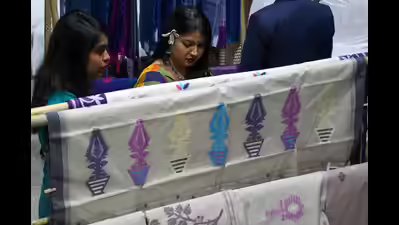
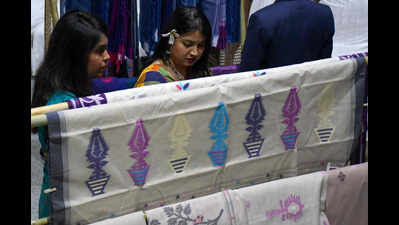
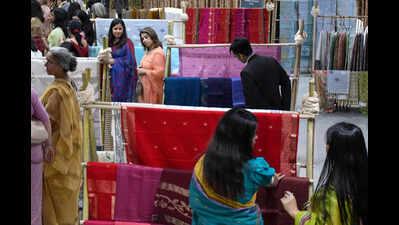
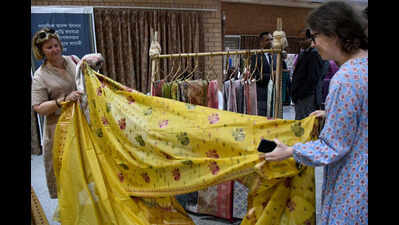
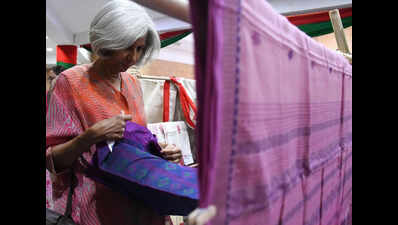
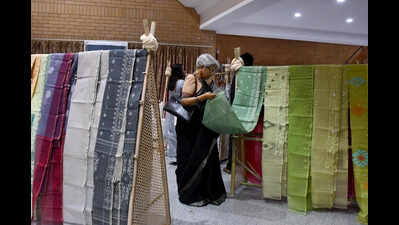
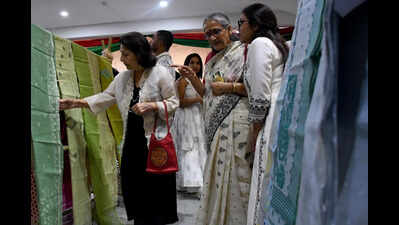
New Delhi: The handloom, unlike a powerloom that functions with mechanical precision, echoes the rhythm of the weaver’s heartbeat.This sentiment set the tone for a first-of-its-kind exposition organised by Bangladesh high commission in India, celebrating the country’s rich handloom legacy with a special focus on sarees from two of its most storied weaving centres, Tangail and Pabna.At the venue in Delhi, yards of fabric flowed like rivers with crimson merging into indigo and yellow brushing against soft ivory. Each saree seemed to hold a story, drawing visitors in. They shuffled between the displays, fingers grazing the textures, pausing, reconsidering and often circling back, unable to settle on one.With over 300 sarees on display, the exhibition — inaugurated on Friday in the presence of diplomats, cultural figures and textile enthusiasts and open to the public till April 21 — offers both abundance and artistry.At its core lies the legacy of Tangail sarees, whose origins stretch back centuries. Shaped in the fertile riverine delta of Bangladesh, these sarees are celebrated for their fine cotton, airy textures and delicate motifs. They are versatile enough for use as everyday wear, yet elegant enough for ceremonial occasions. A defining feature of these sarees is their intricate weaving technique, where extra weft threads are used to create motifs directly on the loom. This approach shares a philosophical kinship with the jamdani weaving, though Tangail expresses it in a more structured and accessible form.Pabna, another historic weaving hub, presents a distinct yet complementary identity. Sarees from this district are known for their durability, subtle patterns and an emphasis on comfort without compromising on aesthetic appeal. Together, Tangail and Pabna, linked by the banks of the mighty Jamuna (Brahmaputra, after it flows into Bangladesh), reflect a balance of refinement within the country’s textile tradition.The exposition also seeks to foreground the lives and legacies of the weavers. Curated by Chandra Shekhar Shaha from Bangladesh and India’s Chandra Shekhar Veda, both veterans in the textile and handicrafts sectors, the exhibition draws our attention to the communities that have sustained these crafts across generations.“These areas are renowned for their long-standing heritage, where weaving traditions have been preserved and passed down within communities. The artisans maintain exceptional standards of quality, which is reflected in the enduring value of their sarees,” said Shaha.Veda stressed the importance of weavers. “What they create is heritage. The weaver moves the thread back and forth across the warp threads, and the interlacing of warp and weft becomes fabric, forming an identity of our culture. We should all contribute to preserving this invaluable heritage for future generations,” he said.Shaha said that the craft transcends borders. “It is fundamentally a human story. Unlike powerlooms, the handloom is connected to the weaver’s heartbeat. The rhythm of weaving reflects life itself. A single saree, especially one as intricate as the jamdani, can take two to six months to complete. That time embodies the weaver’s personal journey, and their emotions and experiences become part of the fabric.”For many families, weaving is not just a profession, but an inheritance passed down three, four or even six generations.The response from the visitors reflected this appreciation. Buyers browsed enthusiastically, often selecting multiple pieces and trying out different colours. The exhibition drew international interest, too. Patricia from the Netherlands said she found it difficult to choose a saree. “I have been looking around for some time and am still trying to decide. I own a few sarees but wear them rarely. This collection is beautiful,” she said.Another visitor, Shama Mohamed, highlighted the importance of authenticity. “Quality is what matters most to me. What stands out here is that there’s no synthetic mix. The sarees come directly from weavers, which makes a big difference. The prices are reasonable and I’ve always liked Bangladeshi sarees,” she said, adding that she ended up buying six of them.