







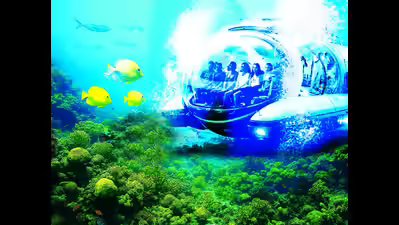
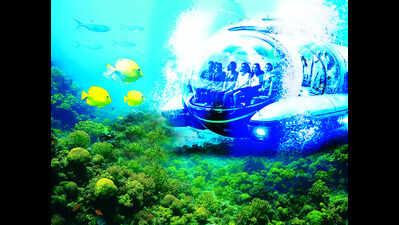
Chennai: In two decades, tourists may be able to descend 500metres below the sea surface in a submersible and get a 360-degree view of submerged ancient settlements and marine life through a transparent dome, as city-based researchers are working on a vehicle for deep-sea tourism.Researchers at the National Institute of Ocean Technology (NIOT) have conceptualised the vehicle as part of the institute’s Vision 2047 roadmap for underwater tourism at sites such as Mahabalipuram, Poompuhar and Dwaraka, where remnants of ancient settlements lie underwater.The proposed capsule is planned as a large manned vehicle capable of carrying 20 to 40 people. According to NIOT officials, the submersible would surface to board passengers and then gradually descend underwater, gliding to depths of up to 500 metres. A transparent dome-like roof is expected to provide a 360-degree view of underwater landscapes, including marine biodiversity and submerged structures.“This will be a deep-sea tourism vehicle where people can sit and witness the submerged ancient cities and marine life like corals up close as the vehicle moves deeper,” said Balaji Ramakrishnan, director, NIOT on the sidelines of Underwater Robotics Workshop (UWR-2026) on Monday.“The vehicle is in conceptual stage and is part of our long-term plan, but there is a constant effort towards its development. After unmanned submersible, we are focussing our efforts on manned submersible now. In each of the technology development and demonstration, we have specific goals. There is a roadmap and there is a progress,” he added.The tourism capsule is being planned as a larger version of Matsya 6000, India’s first manned submersible being developed under the Samudrayaan project. Matsya 6000 is designed to carry three people to a depth of 6,000metres inside a titanium alloy personnel sphere, with systems for life support, buoyancy, navigation, communication and propulsion. It is expected to undergo 500metre depth trials later this year, followed by 6,000metre trials in 2027.However, officials said the deep-sea tourism vehicle would require different electronics and engineering systems because of its larger size and passenger load.“The electronics will be different because we have control and maintain oxygen support for 40 people. The weight matters and buoyancy must be changed accordingly. It will not be proportionately scaled. A lot will be changed in terms of design and components.,” Ramakrishnan said.