








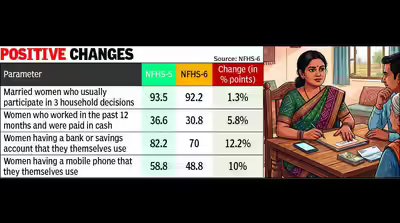
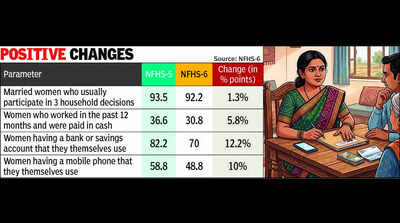
Ahmedabad: More Gujarati women are stepping into paid work, managing their own finances, and taking a larger role in household decisions than ever before, according to the latest National Family Health Survey. Data from the recently published National Family Health Survey, (NFHS)-6, shows improvements across several indicators linked to women’s empowerment between 2019-21 and 2023-24. Gujarat is among the top 10 major states for several of these categories in terms of improvement, indicate statistics.One of the most significant indicators relates to women’s role in household decision-making. The proportion of married women who reported participating in decisions concerning their own healthcare, major household purchases, and visits to family or relatives increased from 92.2% in NFHS-5 (2019-21) to 93.5% in NFHS-6, marking a rise of 1.3 percentage points.The survey also points to a steady increase in women’s participation in paid employment. Under the category ‘Women who worked in the last 12 months and were paid in cash,’ the state recorded a rise of 5.8 percentage points, from 30.8% to 36.6%. Among major states, only a handful recorded larger gains, including Kerala (10.4 percentage points), Jharkhand (9.7), Assam (6.6), Punjab (6.5) and Haryana (6.3).Women’s rights advocates welcomed the trend but said deeper challenges remain. “Women have traditionally contributed substantial unpaid labour within households, while social norms often limited opportunities outside the home. While it is encouraging that more than one-third of women are now engaged in paid work, equal pay, workplace safety and greater representation in the organised sector remain critical concerns,” said an activist from the city.Financial inclusion emerged as another area of substantial progress. The proportion of women who reported having and independently using a bank or savings account increased from 70% in NFHS-5 to 82.2% in NFHS-6, a jump of 12.2 percentage points. The improvement was higher than the national increase of 10.4 percentage points.Under the category ‘Women having a mobile phone that they themselves use,’ the state saw improvement of 10 percentage points from 48.8% in NFHS-5, to 58.8% in NFHS-6. The national rise during the same period stood at 9.7 percentage points. States recording larger gains included Maharashtra and Punjab (13.9 percentage points each), Haryana (13.5), and Himachal Pradesh and Odisha (13.1).