





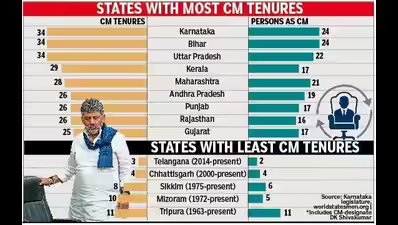
Bengaluru: When DK Shivakumar takes oath as chief minister on Wednesday, it will place Karnataka in an exclusive and politically significant category occupied by only two other Indian states—Uttar Pradesh (UP) and Bihar.Karnataka is set to record its 34th chief ministerial tenure since Independence. That milestone reveals a political history defined by intense competition, shifting alliances, coalition experiments, and periodic bouts of instability.Since the days of the erstwhile Mysore state, Karnataka has had 23 individuals hold the CM’s post across 33 chief ministerial tenures. Shivakumar will become the 24th; his term 34th. Karnataka has had eight spells of President’s Rule—in 1962, 1967, 1972, 1978, 1989, 1990, 2007 and 2008.The numbers put Karnataka on par with Bihar and UP, both of which have also recorded 34 chief ministerial tenures. Bihar has also seen eight spells of President’s Rule and 24 individuals occupy the top office, while UP has had nine periods of central rule and 22 CMs.The comparison is striking because Karnataka, one of India’s economically advanced states, is generally perceived as administratively stable. Yet, beneath that image lies a political landscape that has often been fragmented and fiercely competitive.Karnataka politics underwent a dramatic transformation from the late 1980s, as Congress’ monopoly weakened and regional forces associated with the Janata Parivar emerged as serious challengers. The subsequent rise of BJP created a three-cornered contest that produced fractured mandates, coalition govts, defections and power-sharing arrangements.No episode illustrates this churn better than the succession of govts between 2004 and 2013 when alliances collapsed, CMs changed frequently, and the state endured two spells of President’s Rule.Another measure of political volatility is the number of individuals who have held the office. With Shivakumar’s elevation, Karnataka’s tally of CMs will rise to 24, matching Bihar and exceeding most major states. Tamil Nadu and Odisha, for instance, have had only 15 individuals occupy the post, while West Bengal has had just nine chief ministers over nearly eight decades.Yet, despite political instability, Karnataka’s political system has repeatedly demonstrated its ability to absorb change while maintaining institutional continuity. Despite frequent leadership transitions, the state has emerged as one of India’s most influential economic centres, attracting investment, nurturing the country’s technology sector and sustaining relatively robust democratic institutions.Siddaramaiah’s departure also carries its own historical significance. During his first tenure between 2013 and 2018, he became the first Karnataka CM in nearly four decades to complete a full term. His exit now denies him the distinction of becoming the first CM in Karnataka’s history to complete two full terms in office.Several states have experienced far greater continuity. Chhattisgarh, created in 2000, has had only four chief ministers and no President’s Rule. Telangana, formed in 2014, has witnessed just three chief ministerial tenures involving two individuals. Himachal Pradesh has recorded only 14 chief ministerial tenures since 1966 and has never come under President’s Rule.Even larger states have seen fewer leadership changes than Karnataka. Maharashtra has had 28 chief ministerial tenures, Gujarat 25, Rajasthan and Punjab 26 each, while Tamil Nadu and Odisha have recorded 24.West Bengal stands out with only 20 chief ministerial tenures and nine individuals occupying the office, reflecting long periods of dominance by a single party or representative. None of the UTs that have had CMs have had more chief ministerial tenures than Karnataka.Shivakumar’s elevation, therefore, represents the latest chapter in Karnataka’s uniquely competitive political history — one where authority has rarely remained concentrated for long, elections are closely fought, and changes at the helm are woven into the fabric of the state’s democratic evolution.Total CM TenuresKarnataka* | Bihar | UP24 | 24 | 2229Maharashtra2126 eachGuajarat17StateNo Of Persons As CM3Chhattisgarh (2000-present)48Mizoram (1972-present)511Source: Karnataka legislature, worldstatesmen.org | *Includes CM-designate DK Shivakumar