









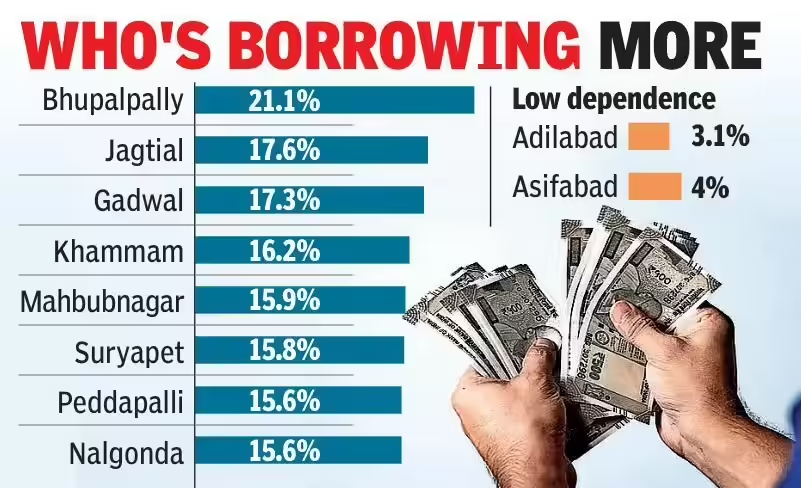
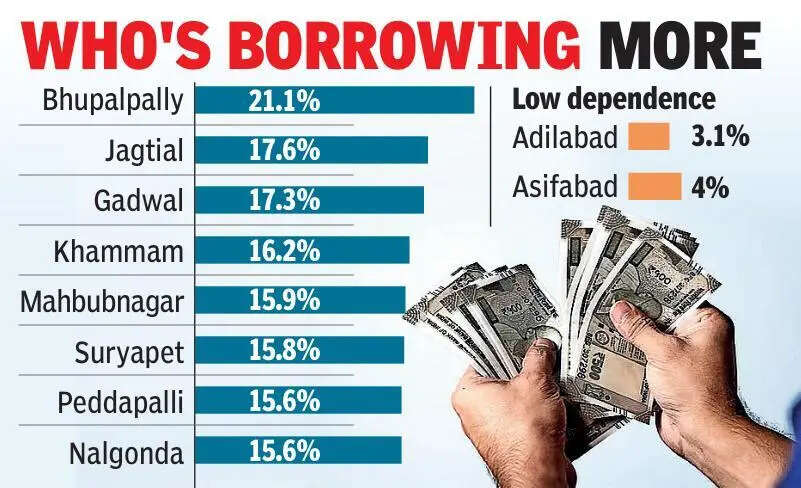
Hyderabad: The Telangana Socio-Economic, Educational, Employment, Political and Caste (SEEEPC) Survey-2024 has revealed a troubling urban credit divide, showing that several towns and district headquarters remain heavily dependent on moneylenders despite being outside the rural economy.While only 3.6% of urban households across the state reported borrowing from moneylenders, the figures rise sharply in many districts, exposing deep gaps in access to banks and institutional finance. The burden is also unevenly shared, with SCs and STs frequently reporting the highest dependence, indicating that urban residence alone has not translated into financial inclusion. Jayashankar Bhupalpally recorded the highest share of urban households taking loans from moneylenders at 21.1%, nearly six times the state urban average. Jagtial followed at 17.6%, Jogulamba Gadwal at 17.3%, Khammam at 16.2%, Mahbubnagar at 15.9%, Suryapet at 15.8%, and Peddapalli and Nalgonda at 15.6% each. At the other end, districts such as Adilabad at 3.1% and Kumuram Bheem Asifabad at 4% reported much lower levels. The contrast suggests that the spread of formal finance across urban Telangana is highly uneven, with smaller towns facing far greater dependence on informal lenders than Hyderabad and better-served urban centres. The survey highlights a clear development imbalance. Though urban Telangana appears less credit-stressed overall than rural areas, several district towns continue to rely significantly on private lenders charging higher interest rates. Jagtial stands out as one of the starkest examples. There, 17.6% of urban households reported borrowing from moneylenders — nearly five times the state urban average. Bhupalpally was even higher at 21.1%, while Peddapalli stood at 15.6%. Khammam, Nalgonda, Suryapet, Mahbubnagar and Gadwal also remained in this range, showing that the problem cuts across regions. Caste disparitiesThe survey also found strong caste disparities within towns. In many districts, SC and ST households reported heavier reliance on moneylenders than others. In Jagtial, 29.2% of urban ST households and 20.4% of SC households reported moneylender loans, compared with 9.6% among other castes (OCs). In Bhupalpally, SC households were highest at 25.5%, followed by ST households at 23.9%, while OCs stood at 10.1%. In Peddapalli, both SC and ST households were at 19.2%, far above OCs at 7.4%. The pattern varied across districts. In Gadwal, ST households stood at 23.4%. In Khammam, dependence was spread across communities, with 17% among STs, 14.9% among SCs, 16.5% among BCs and 16.3% among OCs. The survey linked this trend to exclusion from formal lending systems. Statewide, 6.8% of all households reported loans from moneylenders, with the share at 9.7% among STs, 8.8% among SCs, 7.1% among BCs and 5.1% among OCs.