








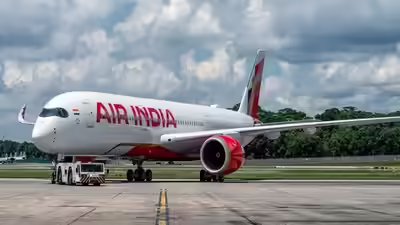
NEW DELHI: An Air India flight bound for San Francisco was forced to return to Delhi on Wednesday after flying for nearly nine hours because of a snag in a critical airborne safety system that helps aircraft avoid mid-air collisions.The problem was linked to the aircraft’s Traffic Collision Avoidance System (TCAS) — a technology that allows planes to electronically “talk to each other” in the sky when they come dangerously close.AI 173, a Boeing 777 carrying around 250 passengers and crew, had taken off from Delhi at 3.09 am and was overflying China when the issue was detected. Since a fully functional TCAS is mandatory for flights crossing the North Atlantic oceanic region en route to the US west coast, Air India decided to turn the aircraft back to Delhi as a precautionary measure.The aircraft landed safely at IGI Airport shortly after noon and was sent for technical checks.Senior pilots explained that TCAS is one of aviation’s most important safety layers. Installed on commercial aircraft worldwide, the system continuously exchanges signals with nearby planes to assess their altitude, speed and direction. If two aircraft are projected to come too close, the system automatically issues coordinated warnings — instructing one aircraft to climb and the other to descend — thereby preventing a possible collision.“Globally, a functional TCAS is mandatory for aircraft flying above 29,000 feet. Some regions have even stricter rules and do not permit aircraft without a working TCAS to enter their airspace at any altitude,” senior pilots said. Such restrictions apply over areas including the North Atlantic corridor, Europe and parts of West Asia.The malfunction meant the Boeing 777 could not legally continue on its planned route to San Francisco, prompting the lengthy turnaround despite the aircraft already being several hours into the journey.In a statement, Air India said the flight returned “due to a technical issue in accordance with laid down procedures”.“The aircraft landed safely and will undergo technical inspection in line with Air India’s safety standards. We regret the inconvenience caused to passengers and are making alternative arrangements to fly them to their destination as soon as possible,” the airline said, adding that passengers were provided refreshments, hotel accommodation and rebooking options.The diversion also highlighted the significant operational cost of long-haul turnbacks. Aviation experts noted that a Boeing 777 burns around 8-9 tonnes of fuel every hour depending on weather and wind conditions, making such technical returns extremely expensive.This is the second such incident involving an Air India ultra-long-haul flight in just over two months. On March 19, a Vancouver-bound Boeing 777-200LR had returned to Delhi after flying for nearly nine hours because the aircraft variant operating the flight reportedly lacked the required clearance for Canadian operations.