









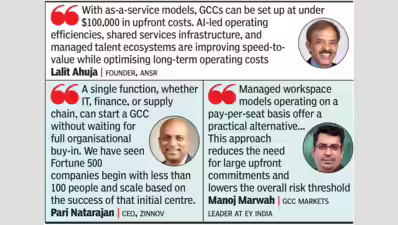
Bengaluru: With India’s GCC ecosystem still having a long runway for growth, the economics of setting up and scaling these centres are changing rapidly, with newer operating models lowering entry barriers.Traditionally, setting up a GCC required substantial upfront investment. According to a recent Kotak report, setup costs ranged between $15,000 and $16,000 per employee, while long payback periods often made the economics difficult for companies evaluating expansion plans.The emergence of GCC-as-a-service providers is changing that equation. Pay-as-you-grow structures help firms avoid heavy capital commitments by converting what was previously a fixed-cost model into a more flexible operating expense structure. This shift is expanding access beyond large enterprises and accelerating adoption.Lalit Ahuja, founder of ANSR, said traditional GCC models involved upfront capital expenditure of $15,000 to $18,000 per employee, with the entire investment committed at the outset. For a 500-employee centre, this could mean roughly $10 million in upfront spending, with returns on investment taking 30 to 36 months. “This was a big impediment for companies to justify the business case for setting up a GCC because of upfront cash requirements and unattractive ROI,” Ahuja said.He said GCC-as-a-service models change the cost structure by converting setup and operating expenses into variable costs, allowing organisations to scale gradually rather than commit large amounts of capital upfront.“With as-a-service models, GCCs can be set up at under $100,000 in upfront costs. AI-led operating efficiencies, shared services infrastructure, and managed talent ecosystems are improving speed-to-value while optimizing long-term operating costs,” he added.Ahuja said no-capex engagement models are pushing the shift further by nearly eliminating initial setup costs and enabling companies to operate with steady-state economics from the outset. “For GCCs with over 1,000 employees, steady-state operating G&A expenses are between 15%-18% of total costs, leaving more resources available for employee compensation,” he said.While entry costs are falling, ongoing operating economics have remained relatively stable. The Kotak report found annual software employee costs typically range between $50,000 and $60,000, with employee-related expenses accounting for 70%-80% of overall GCC costs.Manoj Marwah, GCC markets leader at EY India, said initial capital expenditure per seat for a GCC typically ranges from $7,000 to $10,000. For a 2,000-seat centre, this translates into an upfront investment of approximately $20 million-$25 million.“Managed workspace models operating on a pay-per-seat basis offer a practical alternative, particularly during the early stages when long-term headcount requirements are still being determined,” Marwah said. “This approach reduces the need for large upfront commitments and lowers the overall risk threshold, giving organisations greater flexibility as their plans evolve.”Marwah said India’s GCC model continues to retain a strong cost advantage. “India-based GCCs are expected to continue offering a cost advantage of 60%-70%. Beyond cost, GCCs have historically delivered 10%-12% annual productivity and efficiency improvements, and AI adoption is expected to further strengthen this advantage,” he said.The changing economics are also reshaping the profile of companies entering the market. Pari Natarajan, CEO of consultancy firm Zinnov, said participation is increasingly coming from non-traditional players.“We have set up several GCCs for PE-owned mid-market companies establishing smaller centres in India and are even seeing VC-funded AI companies enter the market,” he said. “These are not the traditional Fortune 500 profiles that historically defined GCC activity.”Natarajan added, “A single function, whether IT, finance, or supply chain, can start a GCC without waiting for full organizational buy-in. We have seen Fortune 500 companies begin with less than 100 people and scale based on the success of that initial centre. This reduces internal risk and accelerates decision-making.”