









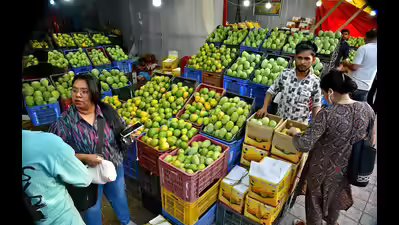
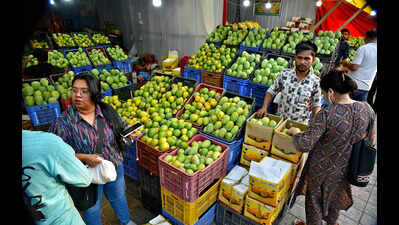
Slice one open, and your neighbour will guess, correctly, what you have brought home from the market. The Kesar mango has always announced itself this way. It is a scent that travels farther than the fruit, and has, for nine decades, sold it faster than any marketing campaign ever could. On Monday, May 25, the Kesar turns 92, a date observed each year by Gir’s farmers, mango lovers, and agricultural scientists. The name was bestowed on May 25, 1934, by Mahabat Khan III, the last nawab of Junagadh, who is said to have tasted the fruit, registered its saffron hue and dense sweetness, and declared it Kesar. Beyond the heartlandProduction has climbed sharply in recent years, from 1.9 lakh metric tonnes in 2020-21 to 3.1 lakh metric tonnes in 2024-25, a jump that reflects both rising demand and the steady spread of Kesar orchards beyond their Junagadh heartland. The variety is now cultivated across Gir Somnath, Amreli, Bhavnagar, Rajkot, Porbandar, Devbhumi Dwarka, and Kutch.Exports to the US, in particular, have grown noticeably. Boxes of Gir Kesar now reach American supermarkets, catering not only to the Indian diaspora but also to local shoppers and other immigrant communities.From orchard to doorstepThe bigger transformation, though, is happening closer to home. The old supply chain — wholesalers buying entire orchards before harvest, organizing the picking, the transport, the cascade through retailers — is dissolving in real time, replaced by a smartphone and a reliable courier.“Whoever has access to and understanding of smartphones is directly selling to consumers,” said Tushar Dhameliya, director of a farmer producer organization representing more than 200 growers in the Gir region. “More than 50 percent of mango farmers are now selling directly to consumers. They have committed buyers who trust them and place repeat orders. Logistics are reliable, and consumers trust farmers directly.”Kisan Sidpara, who tends nearly 25,000 Kesar trees, no longer bothers with the wholesale market at all. “Traders often harvest raw mangoes and artificially ripen them for quick profits, and that is why mango lovers trust farmers like us over traditional traders.”Cutting out the middleman has put a meaningful share of the margin back in the grower’s pocket.While Kesar dominates the commercial trade, an older botanical world survives in its shadow. Most Gir farmers keep a handful of indigenous trees tucked into their Kesar orchards — fruits not grown for the market, but for friends and family. Parshottam Sidpara of Jamka Gir village in Junagadh has set aside a full acre for varieties his grandfather would have recognized — Dudh Pendo, Khodi, Langdo, Vanraj, Rajapuri — and plans to double the area next season. “These mangoes are not easily available today, but every variety has its own specialty,” he said.The competitorsToday, the Kesar has serious competition. Sonpari, developed at Navsari Agricultural University, has won converts with its larger fruit, stronger disease resistance, and tolerance for the unseasonal rain. Pusa Arunima, developed by crossbreeding north India’s Amrapali with the American Sensation, is being watched as a possible alternative for Kesar loyalists who want something familiar but more resilient. And Navpari, NAU’s newest release, is being positioned as another rival. Did you know?The Kesar mango’s story traces back to 1930s Junagadh. Salebhai Idi, a wazir in the nawab’s court, grew an exceptionally sweet variety in his Vanthli orchard, locally called “Salebhai ni Amdi.” Word of this remarkable fruit reached the nawab, who sent his garden superintendent, S K Iyengar, across Indonesia, Malaysia, Singapore, and China to find anything matching its sweetness and aroma, but none compared. “Tasting it himself, the nawab named it Kesar for its saffron-like hue, and rewarded Iyengar with a Rs 3 raise,” says D K Varu of Junagadh Agricultural University. The mother tree, now 155 years old, is said to still bear fruit near Talala.MEET NAVPARI, A SWEETER RIVAL TO KESAR AND ALPHONSOGujarat is set to taste a new variety of mango. Scientists at Navsari Agricultural University (NAU) have released the Navsari Navpari — formally Gujarat Mango-2 — which has received approval for commercial cultivation by farmers. Dr C R Patel, a member of the NAU scientists’ team associated with the variety’s development, said, “Although the fruit size is smaller than Sonpari, its sweetness exceeds that of established varieties such as Alphonso, Kesar and Sonpari,” he said. Navpari recorded a fruit yield of 10.8 tonnes per hectare — about 16 per cent higher than Sonpari, 28 per cent higher than Kesar and 38 per cent higher than Alphonso. Total sugar measured 21.11 per cent, with much of it in the form of sucrose — associated with a deeper, sustained sweetness rather than a sharp hit, closer to a well-ripened Alphonso or Kesar than to lighter hybrid varieties. The fruit also recorded an average weight of 327 g, a pulp-to-stone ratio of nearly 7 and a pulp-to-peel ratio above 5 — comparable to or better than established varieties. Unlike Sonpari, which was developed by crossing Alphonso and Baneshan, Navpari was selected from the seedling population of Sonpari. This means that the female parent is a Sonpari tree, but the pollen (male) parent is unknown. Scientists grew out more than a hundred open-pollinated seedlings from the Sonpari tree, and selected the best-performing one, which became Navpari.The variety has also shown a lower incidence of anthracnose and powdery mildew — the two fungal diseases that routinely damage mango crops — besides reduced infestation by fruit fly and mango hopper. “We will focus on developing mother blocks of the Navpari variety at various NAU campuses, including AES-Paria, this year,” Patel said. “From next year, farmers will be involved in mass production.”A DIFFICULT SEASON FOR GUJARAT’S MANGO BELTIn a normal year, the equation is straightforward. When the yield is less, the price goes up, and farmers absorb a difficult season with the cushion of better rates per kilo. But this is not a normal year. Mango production across South Gujarat has fallen by 20-50 per cent this season, hitting Alphonso, Kesar and other popular varieties alike. By every conventional measure, prices should be rising, but they are not. The reason: air cargo space has either been too expensive to book this year or flight movements too uncertain to rely on.The export collapseMango exports from Gujarat are down by roughly half this season, according to officials at the Agricultural and Processed Food Products Export Development Authority (APEDA). The export figures are unforgiving: about 535 tonnes of fresh mangoes worth $1.86 million in 2025-26, against 856 tonnes worth $2.77 million the year before. “Mango exports have been badly affected by the sharp increase in freight costs,” a senior APEDA official said. “Exporters are also facing serious uncertainty over flight movement and air-cargo availability. Freight rates are more than 50 per cent higher than last year, and many exporters have either avoided taking export orders or shifted sourcing and shipments through Maharashtra.”
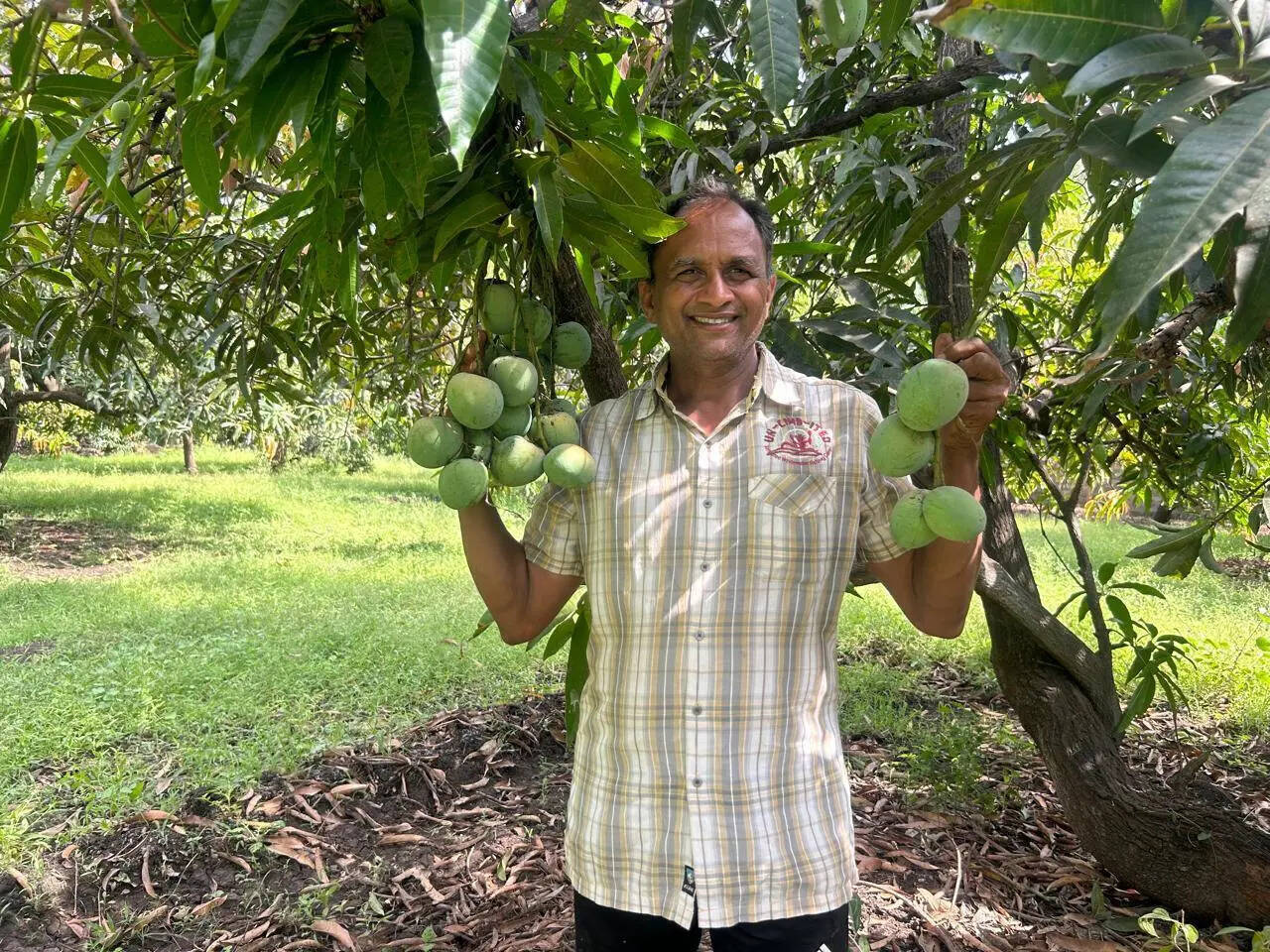
Parshottam Sidpara of Jamka Gir village in Junagadh has set aside a full acre for varieties his grandfather would have recognized — Dudh Pendo, Khodi, Langdo, Vanraj, Rajapuri
The slowdown shows up clearly at the irradiation centre at Bavla near Ahmedabad, the mandatory processing stop for mangoes bound for the US and other regulated markets. “Till mid-May last year, the Bavla irradiation centre had processed around 92 tonnes of mangoes. This year, the figure is only about 49 tonnes by the same time,” another APEDA official said. Freight is only part of the problem. Hiren Ghelani, director of Prime Fresh Ltd, said the fruit itself has been a worry, with the Valsad-Dharampur belt and the Junagadh-Talala area both reporting production issues linked to soil health, heavier fertiliser use and unfavourable weather. “With freight costs rising so sharply, exporters are finding it difficult to remain competitive in international markets,” he said.Shift in demand pattern“Smaller export orders of up to 500kg have dropped noticeably compared to previous years,” said exporter Darshil Shah. “At the same time, there has been some rise in bulk orders of three to four tonnes from markets such as the US, UK, and Canada. Exports to the Middle East, however, are lower this year.” The Middle East has long been the volume buyer that lifted Gujarat prices through the peak marketing period. But now, the reduced export movement has increased dependence on local sales, keeping wholesale and retail rates from rising significantly.Drop in production“Due to the drop in production on my farm, I am not able to earn enough to pay for labour and transport,” said Navin Patel, a farmer in Valsad. “Every year, I grow around 6,000kg of mangoes, but this year the production has dropped to 1,400kg.” “Mango production is less compared to past years even on the farms in hilly areas of Kaprada. It could be due to changes in the weather,” said Alkesh Vejal, a farmer. Traders moving mangoes from farms to local market are seeing the same story from the other side. “Production has gone down for all varieties of mangoes. Still, the farmers are not getting good prices in the market, possibly due to export crisis,” said Jairam Dhodka, who buys directly from growers. For a belt that counts mango income as a defining part of the year’s earnings, the season is shaping up as one of the hardest in recent memory.