









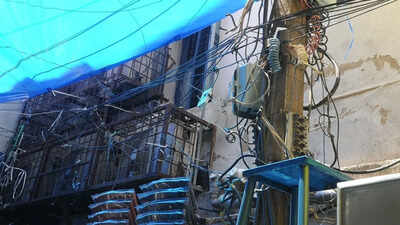
Loose overhead cables pose monsoon safety risk (File Photo)
For Bengalureans stepping out during monsoon, the danger is no longer limited to potholes or flooding — dangling cables overhead and snapped wires on roads have become an equally worrying hazard.Loose telecom wires, fallen internet cables, hanging TV lines and exposed electric wires are now common sights across several parts of the city after rain, turning roads and footpaths risky for both pedestrians and motorists.Heavy rain across Bengaluru repeatedly exposes one of the city’s most neglected infrastructure problems. Fallen trees and collapsing branches often drag down telecom lines, cable TV wires, internet cables and, in some cases, electric connections, leaving behind dangerous clutter across busy roads and residential areas.
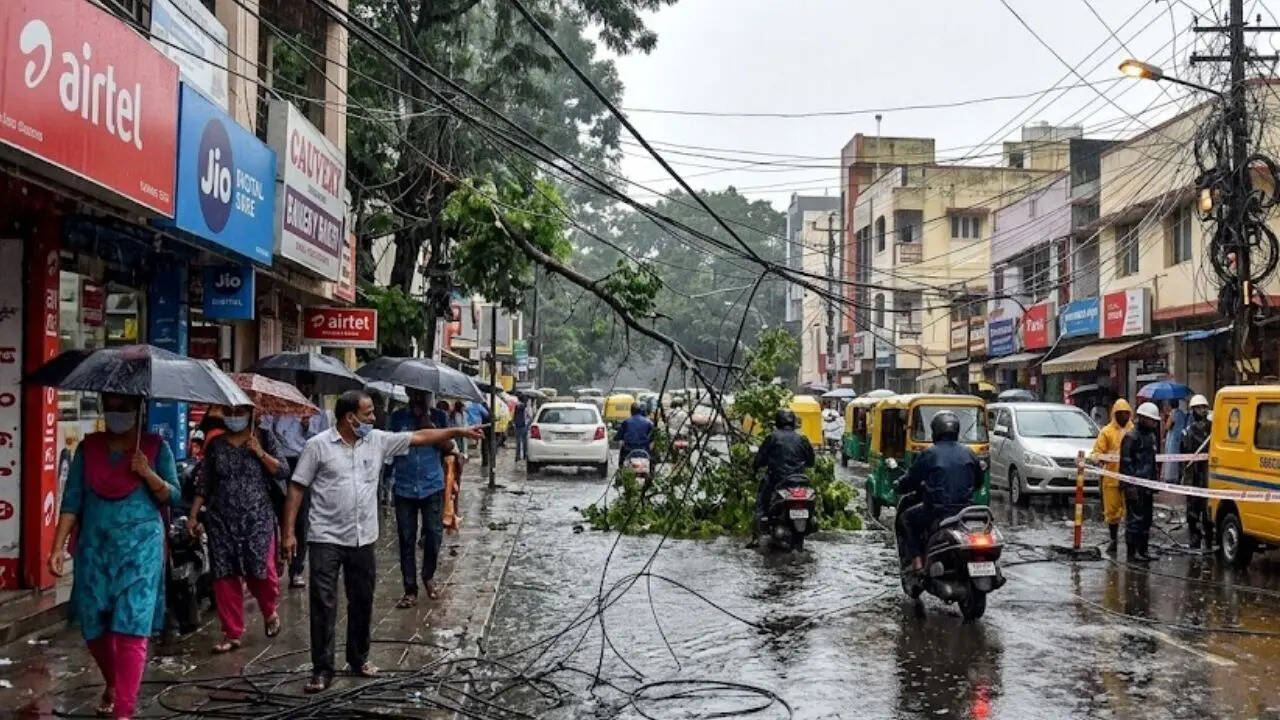
Snapped cables and fallen branches create danger on a rain-hit Bengaluru road
According to officials of the Greater Bengaluru Authority (GBA), hundreds of trees and branches collapse across the city during intense rain spells every monsoon, pulling down a web of overhead cables with them. The consequences can be severe. Cases of electrocution during rain continue to underline the risks posed by exposed or damaged wires left unattended on roads.What was earlier seen as just roadside clutter is now turning into a clear public safety risk.
Footpaths and roads become dangerous after rain
Across several parts of Bengaluru, residents say they now walk cautiously during heavy rain, especially after sunset.Loose cables hanging from low tree branches, wires lying across flooded roads and snapped lines dangling from electric poles have become common sights in many neighbourhoods. In poorly lit stretches, it is often impossible to distinguish a harmless telecom cable from a live electric wire.“The footpaths are veritable death traps,” said Sharmistha K, a resident of Langford Road in central Bengaluru. “Wires dangle dangerously from trees or lie unattended after rain. How is an ordinary person supposed to know which wire is safe?”Residents say the danger increases sharply during evening rain because waterlogging and poor visibility make exposed wires difficult to spot. Pedestrians are forced to navigate around puddles without knowing what lies beneath.
Motorists face similar risks. At South End Circle in Jayanagar, a biker recently panicked after a cable suddenly fell onto his vehicle during rain. Though he escaped unharmed, the incident left nearby commuters shaken, with many initially fearing it was an electric wire. In commercial hubs such as SJP Road and Avenue Road, where roads are already narrow and crowded, snapped cables hanging across buildings and poles have added to the chaos. Traders say shoppers are now constantly alert while walking through these areas after rain.
Unregulated cable network behind the chaos
Residents and traders blame the situation on years of unregulated cable installations across the city.Overhead wires from telecom companies, cable TV operators and internet providers criss-cross roads, trees and electric poles in many areas of Bengaluru. In several places, cables are loosely tied to branches or wrapped around poles without coordinated planning. “Telecom companies and cable TV operators lay cables in a completely haphazard manner,” said Rahul Goyal, vice-president of Karnataka Hardware & Allied Merchants’ Association. “Before monsoon, weak branches should be identified and pruned properly. When branches collapse during rain, they pull down all these cables and create serious danger for both pedestrians and motorists.”
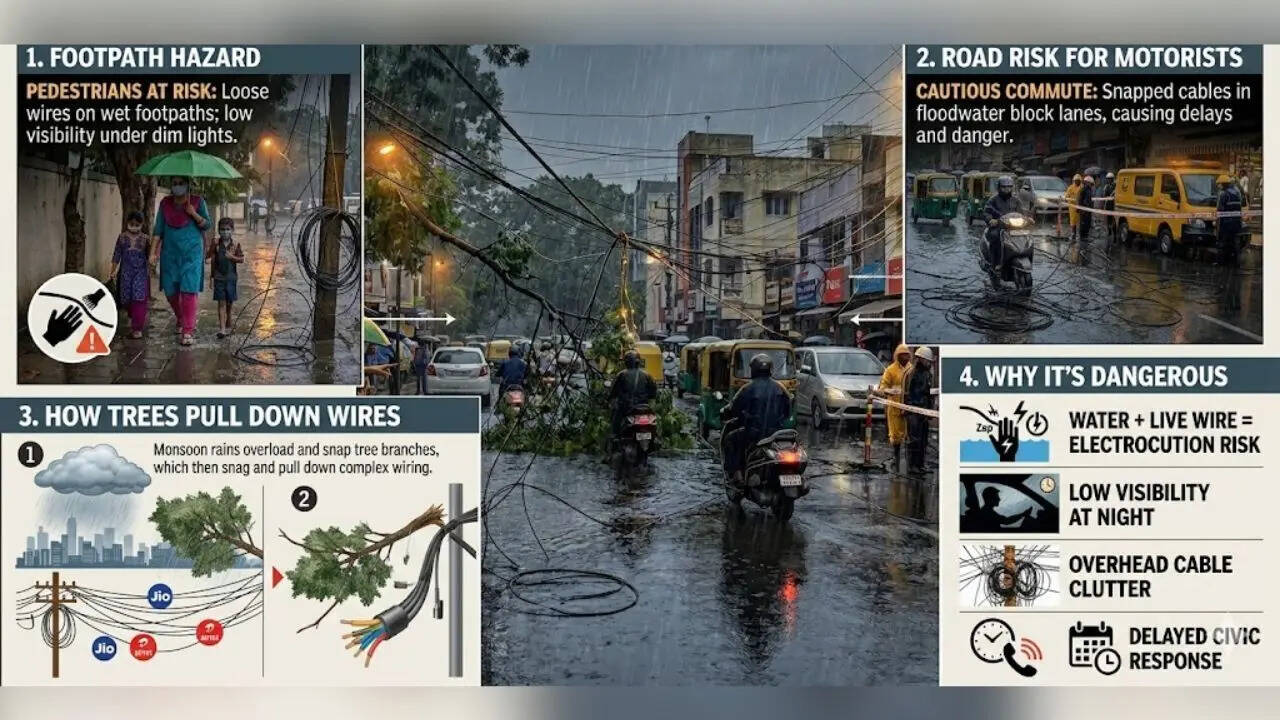
Dangling cables turn Bengaluru roads risky during rain
Traders allege that many old and defunct cables are never removed, adding to the clutter overhead.“No one seeks proper permission before laying these wires,” said Arun Jain, a trader from Avenue Road. “Many cables are no longer functional but continue hanging across roads and buildings for years.”The result is an unplanned overhead network that becomes highly vulnerable during storms and strong winds.
Rain highlights Bengaluru’s dangerous overhead cable clutter
Urban planners say the cable problem reflects a deeper infrastructure failure in Bengaluru.Despite repeated concerns over the years, large parts of the city continue to depend on overhead utility wiring instead of underground cable systems. While newer layouts and select commercial districts have underground infrastructure, older and densely populated areas still rely on exposed overhead lines accumulated over decades.Experts say Bengaluru’s rapid urban expansion has far outpaced infrastructure planning.As internet and telecom services expanded rapidly, many operators chose overhead cabling because it was cheaper and faster to install. Over time, multiple agencies began using the same poles and trees, creating tangled bundles of wires across neighbourhoods.
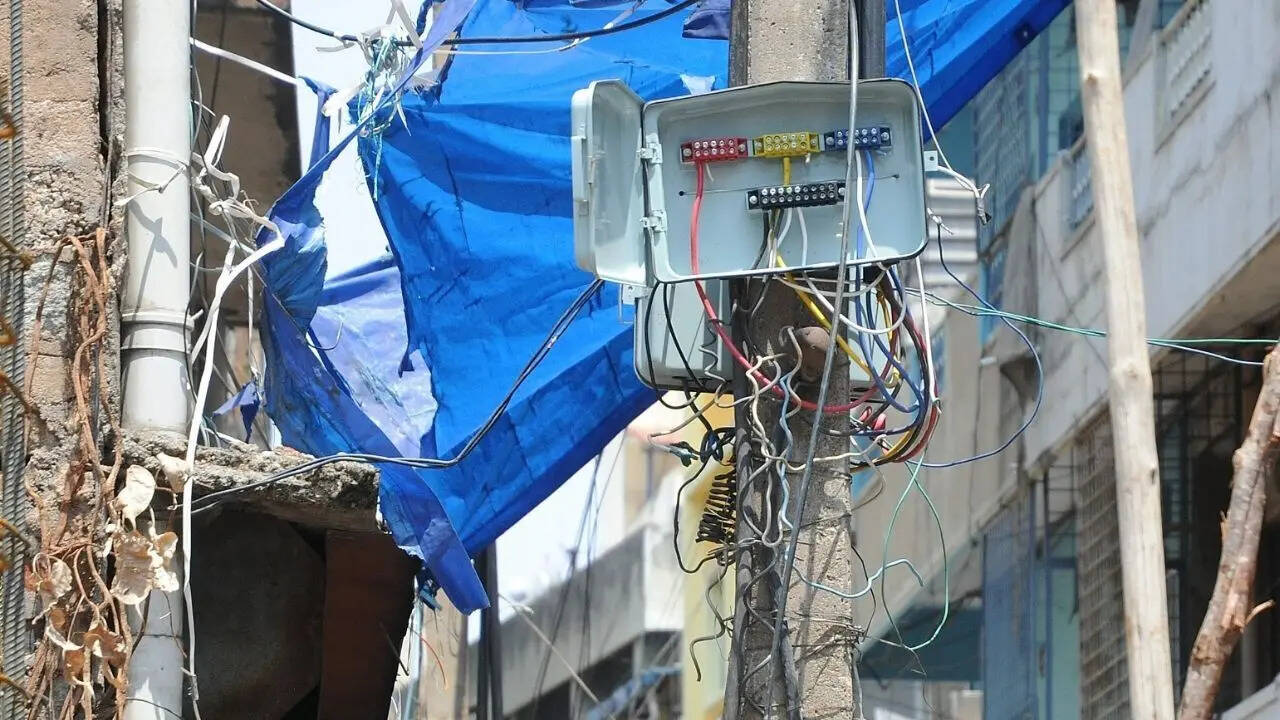
Mess of overhead cables hangs precariously in Bengaluru lane
Former civic officials admit that poor coordination between agencies has worsened the issue.There is often no single authority monitoring all overhead cables in a locality. Electric utilities, internet providers, telecom companies and cable TV operators function independently, making accountability difficult when accidents occur.Residents say this confusion becomes obvious after storms.When trees fall or cables snap, people are often unsure whom to contact. In many cases, damaged wires remain unattended for long periods because different agencies pass responsibility to one another.
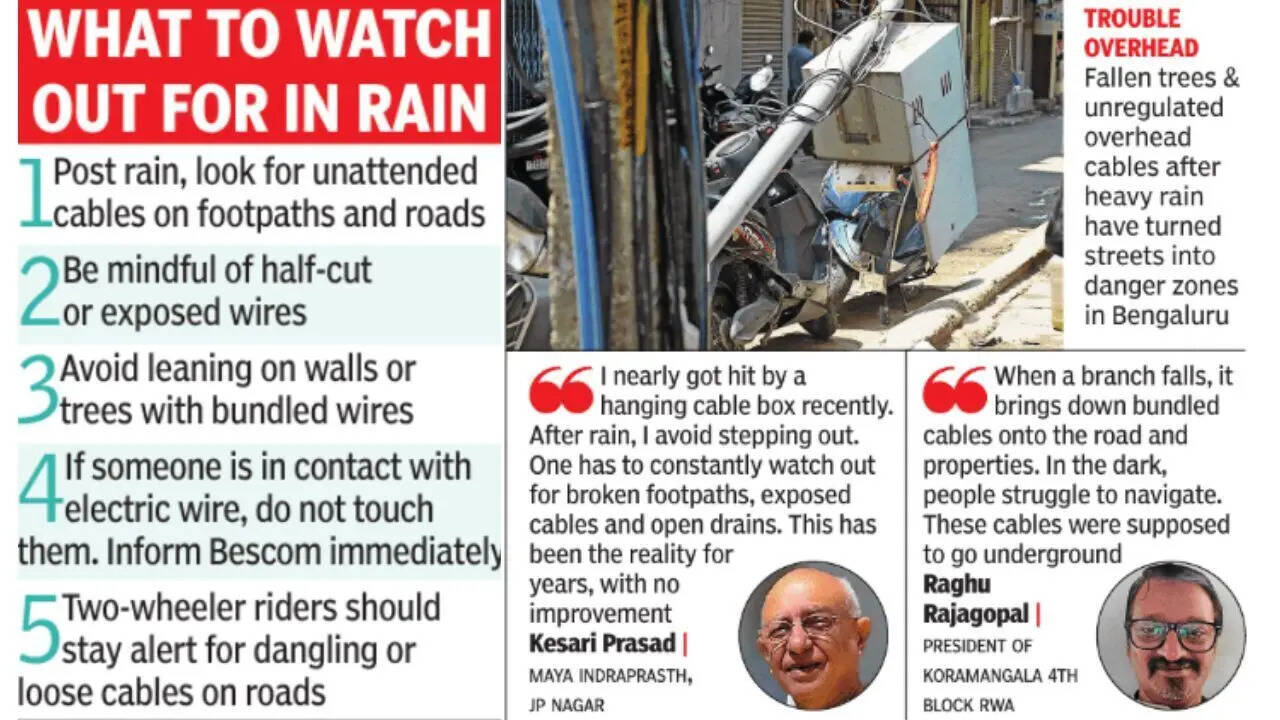
Why dangling cables turn risky during monsoon
Experts say rain in Bengaluru doesn’t just expose weak infrastructure — it amplifies it. One of the most dangerous, yet often ignored, risks is from exposed and snapped electrical and telecom cables.When streets are waterlogged, even a small fault can escalate quickly. A live wire touching standing water, a metal railing or a vehicle can turn hazardous within seconds. Damaged insulation and broken lines only add to the risk.Night makes it worse. Black cables blending into dark, flooded roads are barely visible. People walking or riding through such stretches often have no way of knowing what they are stepping over — or riding past.“During rains, attention goes to potholes and flooding, but exposed wires are far more dangerous because they can be fatal instantly,” said a volunteer associated with a Bengaluru citizens’ collective. “The risk goes up during thunderstorms and power fluctuations.”There is also a structural issue. Bengaluru’s tree cover, while extensive, often clashes with overhead wiring. Branches and cables are frequently entangled. In strong winds or heavy rain, falling branches tend to pull down multiple lines together, leaving entire stretches exposed and unsafe.
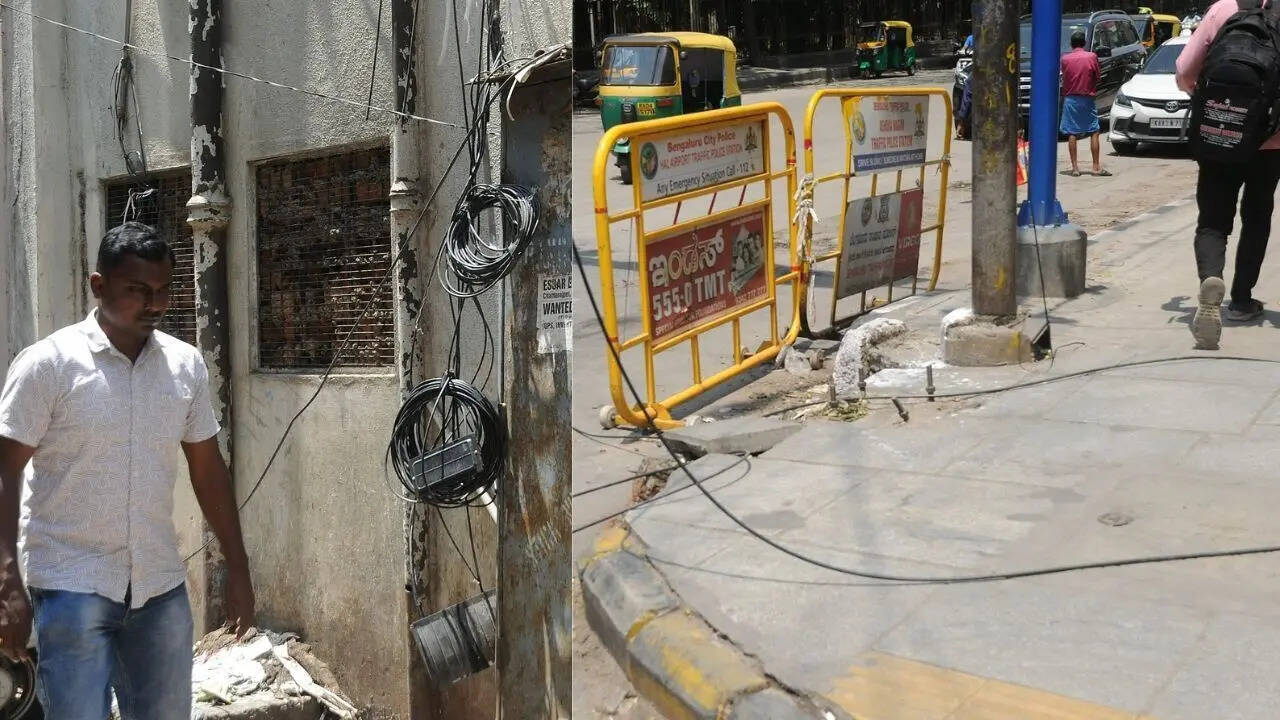
Disorderly utility wires present a public safety issue on a Bengaluru street.
Citizens demand stricter action and underground cabling
With such incidents repeating every monsoon, residents and traders say short-term fixes are no longer enough.The demand for a shift to underground cabling is growing louder. Many argue that overhead networks in dense and old parts of Bengaluru have simply become too risky during heavy rain.At the same time, civic experts say enforcement remains weak on the ground.Residents and traders are also calling for:
- Removal of old and unused cables still hanging across roads
- Mandatory permissions before any new cable installation
- Regular audits of telecom and TV wiring networks
- Pre-monsoon pruning of weak and overgrown branches near poles
- Faster response teams to handle snapped or live wires
- Clear coordination between BBMP, BESCOM and private operators
Experts also suggest that pre-monsoon safety drives and proper mapping of cable networks could reduce confusion during emergencies, where accountability often gets blurred between multiple agencies.
A hidden danger Bengaluru can no longer ignore
For many Bengalureans, the fear now begins with dark clouds.Parents worry about children walking through flooded streets lined with dangling wires. Elderly residents hesitate before stepping onto wet footpaths after sunset. Delivery workers and bikers continue navigating rain-hit roads knowing that a loose cable may appear without warning.The city’s monsoon problems are usually measured in potholes, traffic jams and flooded roads. But unattended cables have quietly emerged as another deadly threat — less visible, but potentially far more dangerous.Until Bengaluru fixes its unregulated overhead wiring and strengthens civic coordination, every spell of heavy rain will continue to leave behind not just waterlogged streets and fallen trees, but also invisible risks hanging dangerously over the city.