









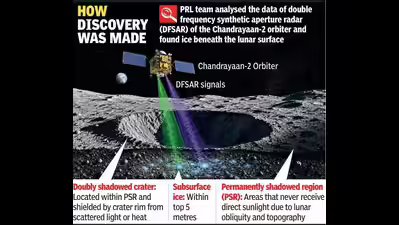
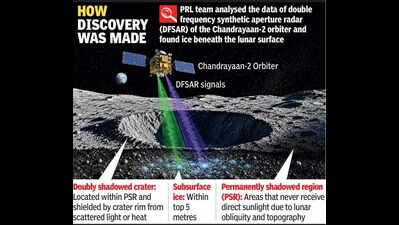
Ahmedabad: There is water in the form of ice crystals beneath the surface of the Moon in the areas where direct or indirect sunlight or heat does not reach, indicates research by a team from the Physical Research Laboratory (PRL) in Ahmedabad. The find is based on the strong radar evidence from data of Chandrayaan-2 mission of ISRO.The radar signatures from the ‘doubly shadowed’ craters in the South Pole region provided new evidence on how water — the lifeblood for any future human plans to use the Earth’s natural satellite for space explorations — is retained for millions of years in absence of atmosphere and extreme temperature fluctuations.Over the past two decades, multiple missions from ISRO, NASA, and other space agencies have provided ample evidence that ice exists at the lunar poles, particularly inside permanently shadowed regions where temperatures remain extremely low. However, the exact form, depth, and spatial distribution of this ice, especially whether it exists within the subsurface mixed within the regolith remains as one of the major unresolved questions in lunar science.The study ‘Subsurface ice in doubly shadowed craters as revealed by Chandrayaan-2 dual frequency synthetic aperture radar’ by Rishitosh K Sinha, Rajiv R Bharti, Kinsuk Acharyya, Sanjay K Mishra, Neeraj Srivastava, and Anil Bhardwaj, was published recently in the Springer Nature NPJ journal ‘Space Exploration’.Sinha, the lead author of the study, said that the deep-impact craters are first and foremost located in the permanently shadowed region (PSR) of the Moon that does not receive direct sunlight. “Moreover, its raised rim additionally blocks the scattered light and thermal emission from the nearby illuminated surfaces. Thermal models suggest that the interior temperature reaches around 25 kelvin (approx. -248°C) which is lower than even some of the outer planets of the solar system,” he said.The team thus focused on these regions for their search for water on the Moon in the form of ice. They used full-polarimetric L- and S-band observations from Chandrayaan-2’s Dual-frequency Synthetic Aperture Radar (DFSAR) to investigate nine doubly shadowed craters located within three craters: Faustini, Haworth, and Shoemaker.The radar scan of the areas showed potential signatures for the presence of ice beneath the surface of four of these nine craters. Simplifying the method of discovery, the team members said that they employed circular polarisation ratio (CPR), noting that radar waves undergoing volumetric scattering within ice-rich material can produce CPR values greater than one.However, rough rocky terrains can also generate elevated CPR values. “To reduce ambiguity from rough rocky terrains, another radar diagnostic known as degree of polarisation (DOP) was used in the study. The regions showing CPR values above 1 and DOP values below 0.13 most likely pointed to the presence of subsurface ice,” said Bharti. “The radar signatures helped identify regions that are likely to host buried ice deposits.“One of the craters inside Faustini crater especially interested the researchers as it showed the possibility that the impact may have been on the surface that may have subsurface ice in the past, and the impact may have been excavated into this potentially buried ice deposit.Chandrayaan missions by ISRO have been instrumental in pointing to the evidence of water on the Moon in the form of ice. Several other studies and probes by other countries also substantiated the belief that the Moon does contain water and that conditions such as permanently shadowed regions with very less temperatures could hold ice stably for millions of years.Anil Bhardwaj, director of PRL and a co-author of this study, said that the latest study adds to the knowledge of the potential location where the future missions could look.The researchers caution that not all craters meet the desired values but instead point to a more potential site compared to others while searching for the scarce water on the Moon. It is notable that both Chandrayaan II and III targeted the South Pole Region of the Moon because of its scientific importance and potential volatile deposits.