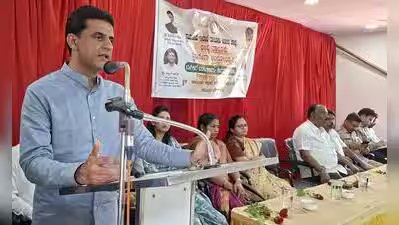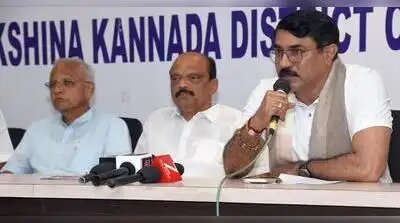









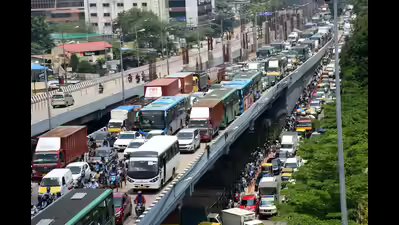
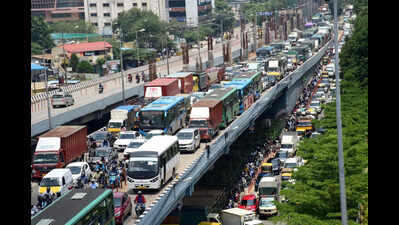
Revenue could be redirected as incentives for employees opting for public transportBengaluru: In another attempt to tackle the chronic congestion choking the city’s Outer Ring Road (ORR), Bengaluru traffic police (BTP) proposed that tech parks explore introducing paid parking to discourage tech company employees from driving private vehicles to work.The proposal was mooted during a stakeholder consultation Wednesday involving traffic police officials, civic agencies, Outer Ring Road Companies Association (ORRCA) representatives and tech park officials as authorities searched for solutions to ease pressure on the city’s busiest IT corridor.According to BTP, free parking inside tech parks has quietly become one of the biggest incentives for employees to continue using personal vehicles despite worsening traffic conditions on the ORR stretch. “If something is offered for free, we tend to take it. When you put a price on it, there is a probability that people might not,” joint commissioner (traffic) Karthik Reddy said while underlining paid parking inside tech parks.According to BTP estimates, 8-10 lakh commuters travel daily through the corridor, which houses more than 500 tech companies and 30 tech parks.Under the proposal, companies could charge employees for parking private vehicles while rewarding those who use BMTC buses, Metro services or carpooling options. Officials also suggested that revenue generated through parking fees could potentially be redirected as incentives for employees opting for public transport.The move comes as Bengaluru’s ORR continues to buckle under mounting traffic pressure, especially along the Iblur–Sarjapur Road–KR Puram stretch. Traffic police believe reducing dependency on single-occupancy vehicles could significantly improve traffic flow on the perpetually gridlocked ORR.Ways to decongest ORR traffic*Encourage carpoolingAccording to police, one of the biggest contributors to traffic congestion is the prevalence of single-occupancy vehicles, with officials claiming that a majority of cars entering tech parks carry only one passenger despite being multi-seater vehicles. To address this, companies were urged to actively encourage voluntary carpooling among employees, which officials described as one of the easiest and quickest ways to reduce the number of vehicles on the road.*Start tech park busesBTP also proposed bus pooling at a tech park level, where large campuses such as Ecospace or Ecoworld could organise common transport for employees travelling from similar localities instead of companies operating separate systems. Officials said this could significantly cut vehicle numbers entering the corridor.*BMTC bus stations inside tech parksTech parks were also asked to allocate dedicated space for BMTC buses to originate or terminate inside campuses, reducing long walks from bus stops. Traffic police urged companies to revive the use of BMTC chartered buses. Before the pandemic, nearly 560 BMTC chartered buses operated for tech firms, but the number has now dropped sharply to just 105 despite offices reopening fully.*Staggered timingsAnother key proposal involved staggered office entry and exit timings, modelled on systems followed in Electronics City. Officials argued that congestion peaks between 9am and 10am and again between 5pm and 7pm, and dispersing employee movement across different timings.*Car-free dayAmong other recommendations, BTP proposed a monthly corporate car-free day, where a set of companies would encourage employees to avoid bringing private vehicles to work on designated days. Officials argued that even a 5–10% reduction in vehicles could considerably ease congestion along the ORR.….but first fix infrastructure: ORRCAWelcoming the traffic police’s efforts , the Outer Ring Road Companies Association (ORRCA) said Tuesday that behavioural changes such as reducing private vehicle usage cannot happen overnight without major infrastructure improvements.Representing companies across the ORR tech corridor, ORRCA said the stretch differs from other employment hubs because of varied work schedules, night shifts and global time-zone dependencies, making uniform mobility solutions difficult.“There is no denying that single-car usage behaviour has to change and people should travel together in pools. But this is not a homogeneous unit. People work across different time zones, customers and work models,” said Manas Das, president of ORRCA.The association said employees have developed commuting habits over several years due to inadequate public transport, poor road conditions and weak last-mile connectivity, making sudden shifts unrealistic. While companies are willing to encourage public transport and adopt mobility incentives, ORRCA stressed that infrastructure upgrades must happen simultaneously.Among its key demands are smaller BMTC buses that can enter tech parks, round-the-clock bus services, safer bus stops with shelters, pothole-free roads and stronger last-mile connectivity. The association also urged authorities to improve feeder roads to the ORR and prioritise mobility upgrades over the next six to eight months as Metro connectivity nears completion.