









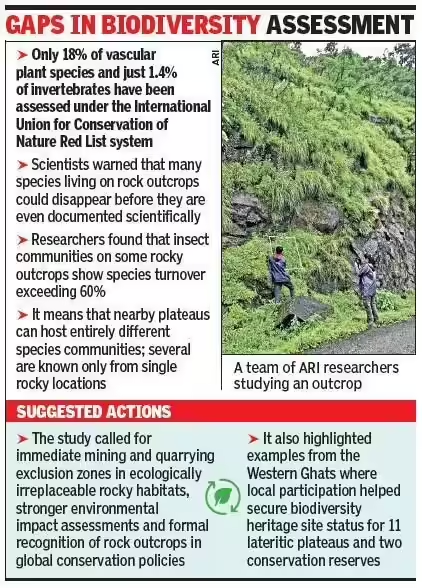
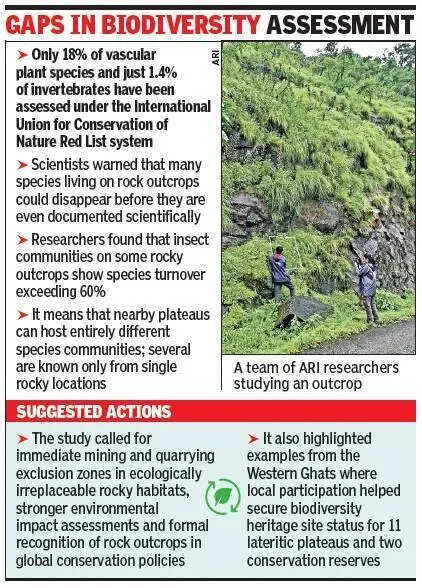
Pune: Rocky plateaus and hill outcrops in the Western Ghats, which appear barren for most of the year but support rare plants, insects and amphibians found nowhere else, are facing growing destruction from mining, quarrying and climate change, a new international study involving Pune-based scientists has said.Published in the Society for Conservation Biology’s Conservation Biology, the study warns that global demand for minerals needed for electric vehicles, batteries and renewable energy infrastructure could sharply increase pressure on such fragile ecosystems across India, Brazil, Africa and Australia.The study by Agharkar Research Institute, Indian contributors like The Green Concept and the IUCN SSC Western Ghats Plant Specialist Group was in collaboration with researchers from Brazil, Australia, Germany, France, Belgium, Italy, South Africa and Burkina Faso.Rock outcrops are naturally exposed rocky landscapes such as lateritic plateaus, basalt cliffs, granite hills and isolated rocky mountains. Scientists describe them as habitat islands because they support highly specialised species that survive in harsh conditions with little soil and water.The study says these ecosystems are often overlooked in conservation planning because they are seen as empty or degraded land. However, researchers found that many rocky habitats contain ancient and highly unique biodiversity that may never recover once destroyed.The paper notes that mining activity linked to energy-transition metals such as lithium, cobalt, nickel and copper is expected to rise nearly five times globally by 2050. Quarrying for stone and construction material is also expanding rapidly in ecologically sensitive rocky regions, including the Western Ghats.“Rock outcrops are among the most neglected ecosystems globally despite their ecological importance,” corresponding author Fernando A O Silveira from Universidade Federal de Minas Gerais said in the study. The researchers warned that destruction of these habitats leads to irreversible loss of species and evolutionary diversity.The study specifically identifies the lateritic plateaus and basalt rock systems of India’s Western Ghats as globally important rocky ecosystems. These landscapes support seasonal wildflowers, reptiles, frogs and insects adapted to extreme heat, water scarcity and shallow soils.Mandar Datar from Agharkar Research Institute, one of the authors, said the ecological value of these plateaus is still poorly understood outside scientific circles. “People often see rocky plateaus as wasteland because they remain dry for much of the year. But during the monsoon they become biodiversity hotspots with many endemic species found only on specific outcrops,” he said.Quarrying permanently alters the original rock surface, making natural recovery extremely difficult. “Once the geological base itself is removed, the ecosystem cannot be recreated in the same way,” Datar said.The researchers also warned that climate change is worsening the threat. According to the paper, many species living on rock outcrops have very narrow environmental requirements and limited ability to move to new habitats. Rising temperatures, droughts and changing rainfall patterns could therefore push several species towards extinction.