







KOLKATA: On May 9, restaurants and tea stalls across parts of Kolkata’s Metiabruz remained glued to television screens broadcasting the swearing-in of Suvendu Adhikari as West Bengal’s first BJP chief minister. For many in the state’s Muslim community, the moment carried a sense of political rupture. The reaction was neither dramatic nor defiant. It was watchful. There is apprehension over what the political transition could mean for representation and social security. But there is also a visible attempt among sections of the community to assess the new government through its actions rather than campaign rhetoric. “We believe in democratic governance, leadership and equality. In a democracy, the government should function for everyone,” said Mohammed Kamruzzaman, general secretary of the All Bengal Minority Youth Federation, as quoted by news agency PTI. “Earlier, we had Mamata Banerjee, and now Suvendu Adhikari has come through a democratic mandate. We expect the government to uphold ‘rajdharma’ and ensure equal treatment for all citizens,” he said. The BJP’s rise has unsettled electoral patterns that had defined Bengal politics for years. Muslim voters, who make up nearly 30 per cent of the state’s population, had largely rallied behind the All India Trinamool Congress in previous elections, especially in 2021 when minority consolidation helped blunt the BJP’s aggressive expansion.
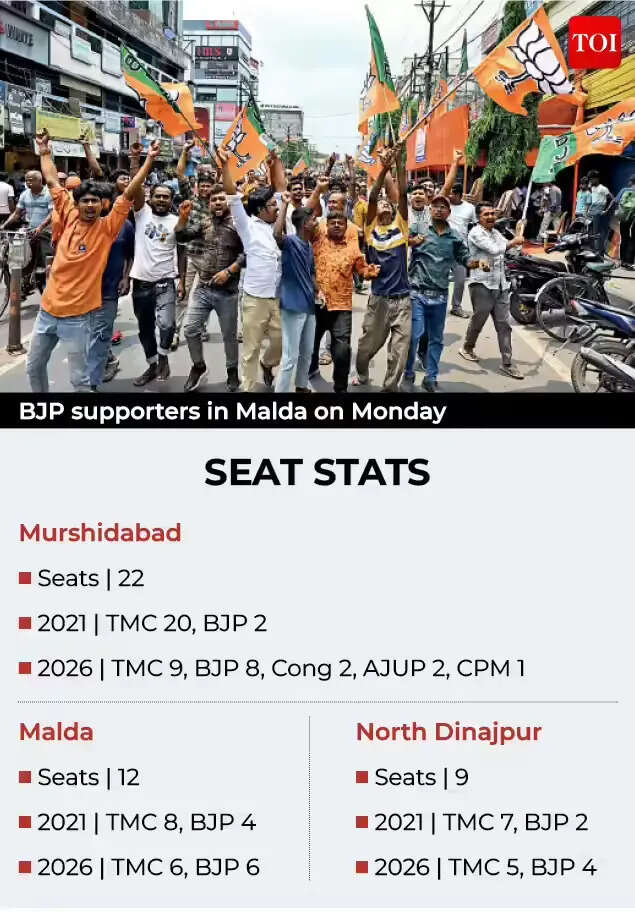
This time, that unity fractured. In several minority-dominated districts, votes were split between the TMC, Congress, Left parties and smaller regional outfits such as Humayun Kabir’s AJUP and the ISF. The shift proved decisive in constituencies where anti-BJP votes had previously remained consolidated. In Murshidabad, where Muslims account for almost two-thirds of the population, the TMC’s seat tally dropped sharply from 20 to nine, while the BJP increased its presence from two seats to nine. Similar trends emerged in Malda and Uttar Dinajpur, signalling deeper political fragmentation within the minority electorate. Although the number of Muslim MLAs declined only slightly — from 44 to 40 — the TMC no longer dominates that space as overwhelmingly as before. Several Muslim legislators now belong to parties outside both the TMC and BJP. Analysts believe multiple factors contributed to the shift, including frustration over local-level factionalism within the TMC and growing dissatisfaction with what some voters viewed as symbolic minority outreach without corresponding economic progress. The Congress and Left also regained pockets of support, particularly in areas where they succeeded in presenting themselves as viable alternatives. Another contentious issue during the election was the Special Intensive Revision of electoral rolls. Around 91 lakh names were deleted across the state. While no official demographic data has been released, opposition parties alleged that many of those removed were Muslims from districts traditionally supportive of the TMC. Still, the election outcome suggested that voter deletions alone did not shape the result. In several Muslim-majority constituencies with healthy turnout figures, the TMC continued to lose ground. In Raninagar, for example, the Congress defeated the TMC while the CPI(M) retained a notable vote share, dividing the anti-BJP electorate. In mixed-population seats, the BJP simultaneously benefited from consolidation among Hindu voters. “The BJP’s immediate priority will be governance and development. There is no reason for panic. Minorities may not receive any additional political advantage, but there could be a more level playing field where development becomes the focus,” political analyst Moidul Islam said, as quoted by PTI. Among younger Muslims and sections of the middle class, conversations are increasingly centred around jobs, administration and stability rather than exclusively identity-based politics. At the same time, anxieties remain strong over representation in the new dispensation, particularly because the BJP did not field a single Muslim candidate in the assembly election. Questions have also emerged over how the government intends to approach minority welfare institutions and whether communal polarisation may intensify despite assurances of inclusive governance. Senior BJP leader Dilip Ghosh avoided directly answering questions on who would lead the minority affairs department, maintaining instead that development should not be seen through a religious prism. Several Muslim organisations, meanwhile, appear to be adopting a strategy of cautious engagement rather than immediate political confrontation. Maulana Shafique Qasmi, imam of Kolkata’s Nakhoda Masjid, said ideological differences should not prevent an elected administration from functioning equally for all communities. “For the government of the day, everyone should be equal,” he said. Md Yahya, chairman of the West Bengal Imam Association, said the community hoped the BJP’s slogan of “Sabka Saath, Sabka Vikas” would be implemented “in letter and spirit”. “We hope people can live without fear and in harmony,” he said.(With inputs from PTI)