







Eastern Uttar Pradesh, or Purvanchal, covering districts such as Gorakhpur, Deoria, Kushinagar, Maharajganj, Siddharthnagar, Basti and surrounding areas, was long synonymous with healthcare neglect.Before March 2017, the region had essentially one major government medical institution: Baba Raghav Das (BRD) Medical College in Gorakhpur. Primary and community health centres were understaffed, critical care was almost non-existent in most districts, and Japanese Encephalitis (JE) along with Acute Encephalitis Syndrome (AES) claimed hundreds to over a thousand children’s lives annually in the peak monsoon months. Families routinely rushed unconscious children to overcrowded BRD wards, only to face high mortality.Yogi Adityanath, as Chief Minister since 2017 and a long-time advocate for the region as its former MP, prioritised multi-departmental interventions under the “double-engine” government framework. The results over nine years include near-elimination of encephalitis deaths, a surge in medical colleges and seats, upgraded tertiary facilities, and expanded primary-to-secondary care infrastructure.
Statewide foundations enabling Eastern UP gains
Uttar Pradesh expanded government medical colleges from roughly a dozen in 2017 to more than 45 by 2025-26, with total colleges (including private and PPP) reaching 80-85. MBBS seats rose from about 4,690 to over 13,600. The “One District, One Medical College” vision brought institutions to previously underserved districts. Every district now has ICU/mini-ICU beds, free dialysis, digital X-ray and blood banks, facilities absent or limited in most places earlier.Ayushman Bharat and state schemes cover over 5-10 crore people for cashless treatment up to Rs 5 lakh. Health budgets scaled up significantly to around Rs 47,000 crore for 2025-26, supporting Emergency Covid Relief Package expansions, Health and Wellness Centres, telemedicine (e-Sanjeevani), and digital systems like e-Sushruta. These statewide shifts were especially transformative for the eastern belt, which had the highest historical disease burden and infrastructure deficits.
Gorakhpur: from regional weakness to medical hub
Gorakhpur, the political and administrative centre, saw the most dramatic upgrade. AIIMS Gorakhpur (112 acres, project cost around Rs 1,011 crore) had its foundation laid by Prime Minister Narendra Modi in 2016. OPD began in February 2019, and the first MBBS batch (initially 50 seats, later 125) started that year. It now functions as a 600+ bed tertiary centre with trauma capabilities, serving eastern UP plus adjoining Bihar and Nepal. Its graduates have performed strongly in national PG exams (INI-CET and NEET-PG), with some securing top ranks.BRD Medical College itself was strengthened: MBBS seats increased to 150, postgraduate seats expanded (recent approvals added dozens across departments, notably paediatrics), and super-specialty services improved. Key additions include a 50-bed Critical Care Block (under Ayushman Bharat Health Infrastructure Mission, Rs 18.7 crore, nearing completion), a 100-bed Level-1 Trauma Centre (Rs 38 crore, under construction with modular OTs and ICU), expanded paediatric ICUs, a dedicated paediatric oncology ward (treating over 100 childhood cancer patients since 2023 with support services), and emerging cardiac surgery capabilities.Private investment followed, including a 250-bed super-specialty hospital with an 80-bed ICU inaugurated in 2025. District hospital upgrades added dialysis beds, ACs and better diagnostics. Collectively, Gorakhpur now produces hundreds of doctors annually and reduces referrals to Lucknow or Delhi.
Deoria and Kushinagar: new colleges and district-level facilities
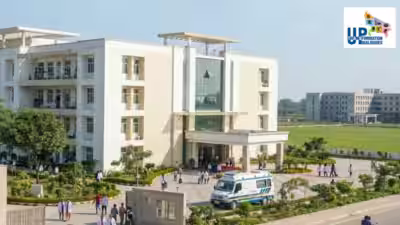
Deoria received the Maharshi Devraha Baba Autonomous State Medical College (functional from around 2021), offering 100 MBBS seats and a teaching hospital on a substantial campus affiliated to Atal Bihari Vajpayee Medical University. It upgraded the former district hospital infrastructure and has ongoing critical care and trauma projects (including additional funding for CCU and trauma centre). This brings tertiary training and care closer for Deoria and neighbouring blocks, easing pressure on Gorakhpur.Kushinagar’s Autonomous State Medical College (classes from 2023-24, 100 seats) features a modern multi-storey 293-bed complex (Rs 280-320 crore) with major and minor OT complexes, 20-bed ICU, advanced pathology and other departments. It was built by upgrading the joint district hospital on additional land. A government nursing college is also in the pipeline on adjacent land under a centrally assisted scheme. These facilities address previous specialist shortages that forced referrals for orthopaedics, surgery and critical cases to Gorakhpur or beyond.
Surrounding districts and regional integration
Maharajganj gained KMC Medical College and Hospital under a PPP model (150 MBBS seats). Siddharthnagar, Basti and others received or are advancing autonomous state medical colleges or equivalent upgrades. The Gorakhpur division overall moved from one medical college to five (plus AIIMS), with annual MBBS output rising toward 675 seats across institutions including a private Shri Gorakhnath Medical College (50 seats). PICUs, Encephalitis Treatment Centres and vector-control infrastructure were concentrated in high-burden areas like Gorakhpur, Kushinagar and Maharajganj. Free services and insurance reduced out-of-pocket costs for rural families across the belt.
The encephalitis turnaround
One of the signature achievements of the Yogi government has been control of JE/AES. Pre-2017, the region saw recurrent outbreaks with high case-fatality. BRD alone recorded hundreds of deaths yearly, and cumulative historical mortality exceeded tens of thousands. Post-2017, the multi-sectoral Dastak campaign (with UNICEF partnership), scaled JE vaccination under Universal Immunisation, fogging/vector control, safe water and sanitation drives, early identification, and expanded paediatric ICUs/referral systems delivered results.Official data show AES cases falling by 94% and deaths by 99% compared with 2017 baselines by 2025. JE followed a similar trajectory. Multiple reports cite zero or near-zero encephalitis deaths in 2023-2025 in the core districts, a milestone after decades of failure. This combined clinical, preventive and social-determinant approach proved decisive.
Broader impact and outlook
Eastern UP’s healthcare access has improved measurably: higher institutional deliveries, surgeries, diagnostics (CT scans and dialysis volumes rose statewide), and digital consultations. Doctor production has multiplied locally, supporting retention in rural postings. AIIMS and upgraded BRD position Gorakhpur as a regional hub for eastern UP, western Bihar and even Nepal.Challenges remain, including staffing gaps in newer colleges, full operationalisation of some under-construction blocks, and equity in remote blocks, but the trajectory from chronic crisis to structured expansion is clear. Under sustained policy focus on infrastructure, disease control, insurance and education, the region has moved from emblem of neglect to a model of targeted public-health recovery within nine years.