









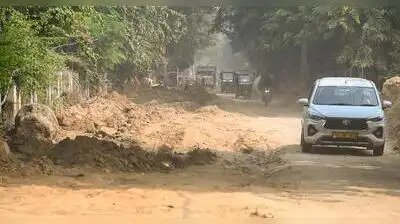
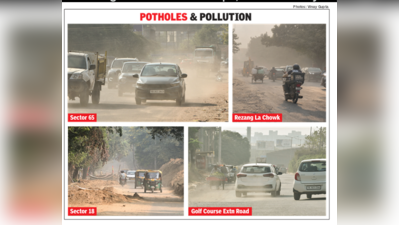
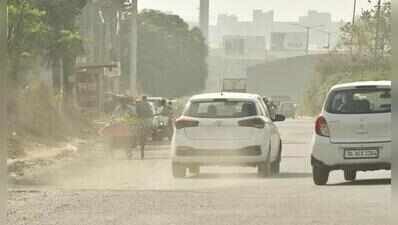
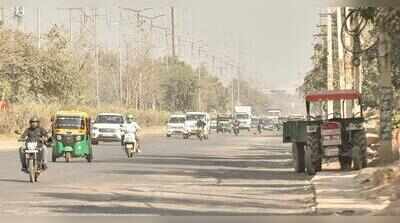
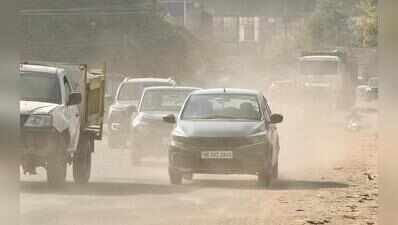
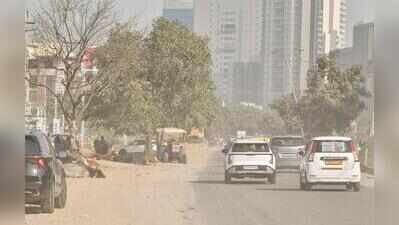
Gurgaon: Mukul Dev had “never experienced” dust allergy earlier but started facing breathing difficulties after regularly using Atul Kataria Road. “I never had any dust allergy, but since I have been using this road and commuting daily, I am having breathing issues,” said Dev. Dev is not alone. From Golf Course Extension Road and Badshahpur to sectors 17, 18, 65, 66 and 67 and Old Delhi-Gurgaon Road — besides Atul Kataria Road — poorly maintained road surfaces and exposed roadside areas are leaving loose material vulnerable to being lifted by passing vehicles.Broken road surfaces, unpaved shoulders, open drains and heaps of construction debris are adding to the city’s dust burden, with commuters navigating dusty stretches across the city even as air quality remains in the poor category. Commuters, particularly those travelling on two-wheelers and pedestrians using these stretches, are exposed to dust as vehicles pass over damaged surfaces and unpaved road margins. Some were seen wearing masks while travelling through the affected areas.A ground-level assessment across these areas found large patches of exposed soil, uneven road edges, unpaved shoulders and construction and demolition debris lying along several stretches. The problem was particularly visible near IFC Centre, opposite St Xavier’s School in Sector 66, where loose earth and rubble lay close to moving traffic. Similar dusty conditions were observed in sectors 17 and 18, as well as along parts of Golf Course Extension Road and around Badshahpur and sectors 65 and 67.Construction debris was found accumulated at several locations, with loose material exposed to traffic. On Old Delhi-Gurgaon Road, dust was seen flying as vehicles moved along stretches with exposed surfaces. Open drains and uncovered roadside sections added to the problem, with loose soil along their edges vulnerable to being disturbed by passing vehicles. In parts of the DLF area, large heaps of exposed soil and road material were also visible close to traffic.The visible dust problem comes against the backdrop of elevated particulate pollution in the city. The city recorded an official daily AQI of 277 on Nov 24, remaining in the poor category. A separate assessment based on Central Pollution Control Board (CPCB) monitoring-station readings for the 24 hours until 9am on Nov 25 put the city’s AQI at 291, also in the poor category. Haryana State Pollution Control Board (HSPCB) has written to civic agencies and the traffic police, asking them to ensure dust-mitigation measures in their respective areas and submit weekly reports on the steps being taken.Atul Kataria Road, which leads towards Signature Road, presented another picture of the city’s dust problem. The stretch beneath the elevated structure was covered with loose soil and dust, with heaps of earth and debris accumulated along the edges. Cars were parked along both sides of the narrow road, while vehicles moving through the stretch stirred up dust, creating a visible haze. The road surface and adjoining areas appeared heavily covered with loose material, leaving commuters exposed to dust during their daily journeys.The combination of damaged road surfaces, exposed earth and accumulated construction debris creates repeated opportunities for dust to be resuspended. Vehicles moving over these surfaces and passing roadside heaps can lift settled particles into the air, exposing pedestrians, two-wheeler riders, shopkeepers and residents living along the roads. Without regular removal of debris, mechanised sweeping and proper maintenance of road shoulders, the same stretches can continue generating dust even after intermittent cleaning.For residents, the problem extends beyond the winter pollution season. “I take this road daily and have been suffering from cough and eye infection throughout the year. Dust is persistent all round,” said Sanjeev Shukla, a resident of Sector 65. The problem is not confined to the locations covered in the ground assessment. A list of 12 identified pollution hotspots in the city includes several locations across the city’s residential, commercial and industrial belts. These include the Basai-Dwarka Expressway intersection, Baba Brahmanand Chowk, Leg 3 End Point, Chintels Chowk in Sector 114, Bajghera, Golf Course Extension Road near Badshahpur and Sector 65 (IFC Chowk), Raghvendra Marg in Sushant Lok 2, Sector 55, and Golf Course Extension Road opposite DLF The Arbour in Sector 63.The list also identifies the Bandhwari landfill site, the road to Radisson Hotel in Udyog Vihar at its junction with NH-8 near Sector 44, Udyog Vihar Phase V and Sector 57. The inclusion of multiple locations across the city, including two stretches along Golf Course Extension Road, points to the wider geographical spread of the identified pollution hotspots. The list, however, does not establish that road dust is the cause of pollution at every location.HSPCB regional officer Harish Sharma told TOI,“We have written to GMDA, MCG and the traffic police to ensure dust mitigation measures are taken in their respective areas and also submit weekly details with HSPCB. We have written to them on Saturday. We will analyse these details once we receive them. Also, we are monitoring all hotspots in the city.”“Road dust is among the pollution sources that civic agencies can directly address through regular mechanised sweeping, removal of accumulated soil and construction debris, repair of damaged road surfaces and paving or greening of exposed roadside areas. Open drains and uncovered roadside sections also require attention to prevent loose soil from becoming another source of dust. Construction material and excavated earth need to be properly stored, covered and transported to prevent it from spreading onto roads,” an HSPCB official told TOI.A GMDA official said, “Paving of the shoulders along Golf Course Extension Road is underway. We will also repair all potholes along the stretch and undertake dust-control measures. Sweeping and removal of accumulated dust along the Atul Kataria Chowk stretch will also be carried out.”Coming back to the air quality index in the city, particulate matter readings displayed on a pollution-monitoring dashboard on Nov 25 showed PM2.5 averaging 274 micrograms per cubic metre over the preceding 24 hours, with the concentration peaking at 500 micrograms per cubic metre. PM10 averaged 205 micrograms per cubic metre, with the maximum touching 484 micrograms per cubic metre. The hourly PM2.5 graph showed a sharp rise during the evening, with concentrations crossing 300 micrograms per cubic metre and reaching close to 500 before declining overnight. At 1 pm on Nov 25, the latest PM2.5 reading was 89.1 micrograms per cubic metre. The PM10 readings are particularly relevant to the road-dust problem. Coarse particulate matter can originate from resuspended road dust, soil and construction activity. When vehicles move over dusty surfaces or pass accumulated debris, settled particles can become airborne again.The extent of the road-dust problem has also been flagged by Commission for Air Quality Management (CAQM). During an inspection drive on Oct 14, four flying squads examined 52 road stretches covering around 104km across the city to assess visible dust and the effectiveness of road-cleaning and sweeping operations. The inspection found 258 violations, including high levels of visible road dust, accumulation of construction and demolition waste along roadsides, damaged footpaths and potholes. Of these, 174 violations were recorded on roads under MCG, while 84 were on stretches under Gurugram Metropolitan Development Authority (GMDA). The inspection covered around 56km of MCG roads and 48km under GMDA.The findings were part of CAQM’s continued enforcement of dust-mitigation measures. An earlier inspection of 125 road stretches under MCG on Dec 26, 2025, had found high levels of visible dust on 34 stretches and moderate levels on 58. Another 29 stretches had low levels of dust, while only four were found to have no visible dust. The commission also flagged a large number of public complaints. As of Oct 13, it had received 1,135 complaints concerning road-dust pollution against MCG and 183 against GMDA through social media platforms.During a hearing on Nov 3, MCG told the commission that deep cleaning of roads was being carried out regularly. The civic body also informed it that mechanical road-sweeping machines were operating at an efficiency level of around 50-60%, and proposed increasing this to 80% by mid-Nov. It assured the commission that door-to-door waste collection and processing would be ensured by mid-Nov. However, CAQM observed that these assurances did not address the deficiencies already documented during inspections. Taking note of repeated lapses, the commission authorised MCG to initiate a complaint/prosecution before the jurisdictional judicial magistrate against an executive engineer and other officials, if responsible, for failures in road-sweeping operations and implementation of dust-control directions.