





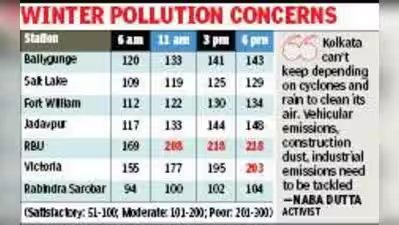
Kolkata: The clean-air advantage Kolkata enjoyed following successive cyclonic storms and the accompanying rain has now worn off with a dip in temperature.The deterioration in the city’s ambient air quality was evident from the fact that two continuous ambient air quality monitoring stations (CAAQMS) slipped into the ‘poor’ category from ‘satisfactory’ and the rest five turned ‘moderate’ by Thursday evening, signalling the onset of the winter pollution cycle. As the atmospheric temperature inversion traps pollutants closer to the ground, the ambient air quality worsens steadily. What makes this current deterioration in the air quality particularly worrying is that it is being driven by PM2.5, microscopic particulate matter capable of penetrating deep into the lungs and entering the bloodstream, increasing the risk of respiratory and cardiovascular ailments.The monitoring station at Rabindra Bharati University (RBU) on BT Road was the first to turn ‘poor’ as its AQI rose from 169 at 6 am to 208 at 11 am and 218 by 3 pm. Victoria Memorial, despite its proximity to the sprawling green expanse of the Maidan, followed suit, with its AQI climbing from 155 at 6 am to 203 at 6 pm.Not only these two but the five other stations in the city also showed evidence of winter pollution. At Jadavpur, the AQI rose from 117 to 148, at Ballygunge, from 120 to 143, at Fort William, from 112 to 134 and at Salt Lake, from 109 to 129. Even Rabindra Sarobar, which remained the city’s least polluted location, lost its ‘satisfactory’ air quality status by afternoon.“The successive spells of rain had scavenged suspended particulate matter from the atmosphere. But with the temperature dipping, wind speed weakening and atmospheric mixing becoming less effective, pollutants are increasingly getting trapped within a shallow layer close to the ground. Unless meteorological conditions change, we may witness a progressive build-up of particulate matter,” said a state Pollution Control Board scientist.Environmentalists, such as Naba Dutta, expressed concern over the city’s dependence on favourable meteorological conditions rather than sustained emission-control measures to maintain clean air. “Kolkata cannot keep depending on cyclones and showers to clean its air. Vehicular emissions, construction dust, waste-burning and industrial emissions need to be tackled,” he said.For residents, particularly morning-walkers, children and senior citizens, the poor AQI renewed concerns over outdoor exposure. “The air felt noticeably fresher after the rain, but the respite appears to have been short-lived,” said S M Ghosh, a morning-walker at Rabindra Sarobar.