






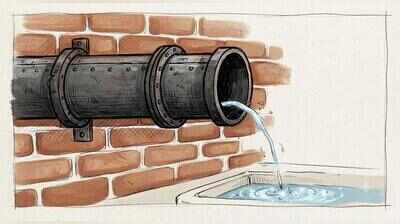
Bengaluru: Nearly half the sewage the city generates daily is not treated properly, and the full fix is about three years away, according to Bangalore Water Supply and Sewerage Board (BWSSB).The city produces about 2,580 million litres per day (MLD) of sewage, but BWSSB’s 34 sewage treatment plants (STPs) can treat only 1,348.5 MLD. That leaves 1,231.5 MLD left entirely or inadequately treated.As per the water authority, 45 new STPs with a combined capacity of 1,163 MLD will be added in phases between Dec 2026 and Sept 2029. Only 117 MLD of this is due by the end of this year, while the largest addition — 335 MLD from four plants — comes at the very end of the schedule.A senior official said: “Bengaluru’s growth has outpaced its water and sewage infrastructure, and we’re working on both fronts at once. Today, the city’s demand is met only because borewells supply about 800 MLD of water alongside the Cauvery; that balance will not hold as population rises. That’s why we’re adding Cauvery Stage VI, expanding reuse of treated wastewater, promoting rainwater harvesting and groundwater recharge, and cutting distribution losses.”When asked about quality assessment, the board said an independent end-to-end audit of water quality standards was under way, while the Indian Institute of Science (IISc) was separately assessing the quality framework to validate the findings.“An independent audit of treated water quality is under way, alongside an IISc assessment, because capacity alone isn’t enough. Our real-time dashboard already tracks compliance with KSPCB (pollution control board) norms. A master plan up to 2046 will guide investment in the newly added areas,” the official added.BWSSB said it is expanding its sewage treatment infrastructure in the long run through multiple funding sources, including the World Bank (nine STPs, Rs 1,000 crore), Urban Challenge Fund (nine STPs, Rs 1,350 crore), and JICA (14 STPs, Rs 968 crore). The board said these projects would help bridge the gap between sewage generation and treatment and prevent pollution of waterbodies.DEMAND & SUPPLY (2026)* Water demand: 2,650 MLD* Supply: 2,720 MLD* Surplus: 70 MLDWhere water comes from* Cauvery: 1,920 MLD* Borewells: ~800 MLD* Without borewells, city would face deficit of ~730 MLDWHAT’S REQUIRED (As per BWSSB)* Bengaluru Metropolitan Region faces a 3,600-MLD water deficit* 4,000-4,500 MLD of supply and savings possible by 2037* Rs 25,500-crore investment needed1. Bulk water* Cauvery Stage VI: 500 MLD (₹7,000-crore investment)* Yettinahole: 50 MLD (counted within the ₹7,000 crore)* Network optimisation: 50-100 MLD (₹300 crore)* 550 MLD of extra supply planned to serve peri-urban towns2. Treated water reuse* Industries and institutions: 900-1,100 MLD (₹1,200 crore)* Agriculture: 800-900 MLD (₹1,500 crore)* 2,000 MLD of new tertiary treatment capacity* 150km purple network linking STPs to hubs* 40+ storage tanks and a canal network3. Agricultural water optimisation* Saves 300-400 MLD (₹2,500 crore)* Drip and micro-irrigation in command areas* Shift to less water-intensive crops4. Groundwater recharge* Adds 1,100-1,200 MLD of water (₹5,000 crore)* Lake rejuvenation and aquifer recharge* Recharge wells and stormwater harvesting5. Non-revenue water reduction* Saves 300-400 MLD (₹5,000 crore)* District Metered Area-based metering and leak detection* Pressure management and pipeline replacementTotal investment* Total potential: 4,000-4,500 MLD, for ₹22,500 crore* 4,000km sewage network to connect inflow: ₹3,000 crore* Total investment by 2037: ₹25,500 crore— Source: BWSSB