







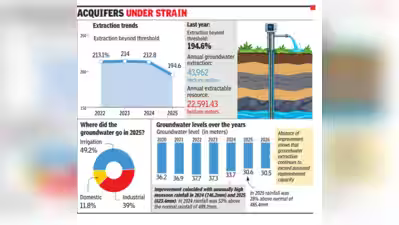
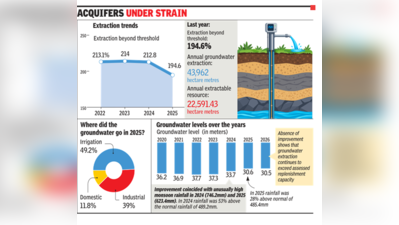
Gurgaon: After three consecutive years of improvement, the city’s groundwater recovery appears to have lost momentum. Its average pre-monsoon groundwater reading remained virtually unchanged in June 2026. The district average stood at 30.5, compared with 30.6 metres a year ago, indicating that the gains recorded after years of decline have not translated into further improvement.Data from the district groundwater cell, covering 62 monitoring locations across four blocks, showed that the city has effectively retained the improvement recorded in 2025, when the average groundwater depth reached 30.6 metres, its shallowest level in nearly a decade. The latest readings suggest that the recovery has plateaued, even as pressure on groundwater resources remains high. The longer-term trend shows how the city’s groundwater situation deteriorated before recovering. Council on Energy, Environment and Water (CEEW) fellow Nitin Bassi said growing demand for groundwater across NCR, coupled with private control over the resource and subsidised power, was contributing to excessive and inefficient use.Gurgaon has remained classified as an overexploited groundwater assessment unit since 2013. A govt assessment cited in last year’s report showed that the city extracted 212% of its permissible annual groundwater limit in 2024, withdrawing around 43,262 hectare metres against a recharge capacity of 20,333 hectare metres. It ranked third in Haryana for groundwater over-extraction, behind Kurukshetra and Panipat.“Improving the groundwater table in Delhi–National Capital Region (Delhi–NCR) remains a major challenge due to complex hydrogeology, dense urbanisation and changing precipitation patterns,” research scientist (climate, environment and sustainability sector) at Center for Study of Science, Technology and Policy (CSTEP) Manish Kumar told TOI.In 2018, the pre-monsoon water table stood at 33.2 metres. It subsequently declined to 35.8 metres in 2019, 36.2 metres in 2020, 36.9 metres in 2021 and 37.7 metres in 2022. The reversal began in 2023, when the average improved to 37.3 metres, followed by 33.7 metres in 2024 and 30.6 metres in 2025. The improvement coincided with unusually high monsoon rainfall in 2024 and 2025. Experts had cautioned that the recovery was largely rainfall-driven rather than the result of a fundamental change in how the city extracted and replenished groundwater.“Rainfall-driven gains alone may not be enough to reverse the long-term pressure on aquifers,” a senior hydrologist at the groundwater cell in Haryana told TOI, adding, “While the city has retained the gains made during the past three years, the absence of improvement in 2026 clearly shows that groundwater extraction continuing to exceed assessed replenishment capacity.”Climate, environment and sustainability sector research scientist at CSTEP Manish Kumar said, “Any improvements in NCR’s groundwater level will need considerable efforts towards the four Rs, which are: First, reduce extraction by regulating new borewells in over-extracted blocks such as those in the south and southwest parts. Secondly, recycle rainwater for domestic purposes through enforcement and audits of rainwater harvesting systems in all large buildings, housing societies, institutions, and industries. Thirdly, reuse treated wastewater by pushing for zero discharge from large buildings, industries, and institutions; and fourthly, recharge shallow aquifers by reviving existing natural drainage systems, lakes, and ponds, while protecting critical recharge areas such as the Yamuna floodplains. In addition, urban permeability should be improved through nature-based solutions such as bioswales and permeable pavements,” Kumar said.Bassi (CEEW) added, “National Capital Region (NCR) continues to grow and so is the demand for groundwater. This coupled with a private control over groundwater and subsidised power leads to cases of the excessive and inefficient use of water. The aquifers in NCR is one connected system; a holistic approach to regulate groundwater for domestic, industrial and agricultural purposes is crucial to manage its overuse. Further, to reduce dependence on groundwater, a circular economy approach needs to be integrated in region’s water resources planning. As per CEEW analysis, in addition to reducing pressure on freshwater resources, this can unlock market and investment opportunity of nearly $35 billion by 2047 in India.”The latest block-wise readings showed that Pataudi recorded the highest average at 37.7, followed by Gurgaon block at 33.7. Sohna recorded an average of 25.9, while Farukhnagar had the lowest block average at 22.6. Pataudi’s groundwater situation remained particularly concerning, with Panchgaon recording a reading of 51.2, followed by Unchamajra at 47 and Bhora Kalan at 46.7. In Gurgaon block, the most extreme reading was recorded at HSIDC, at 117.4. Chakarpur recorded 75.5, followed by PS Sector 29 at 61.25 and Wazirabad at 51.5. Kherki Daula also recorded a reading of 47.45.Across the city, 11 of the 62 monitoring locations recorded readings exceeding 40, while five recorded 50 or higher. All five locations in the latter category were in Gurgaon and Pataudi blocks: HSIDC, Chakarpur, PS Sector 29, Wazirabad and Panchgaon. The readings also highlighted sharp variations within individual blocks. Dharampur in Gurgaon block recorded the lowest reading at 2.5, followed by Dhankot at 3.15 and Budhera at 4.15. In Sohna, Raisina recorded the highest reading at 38.3, while Gangola recorded a much lower reading of 4.1.