







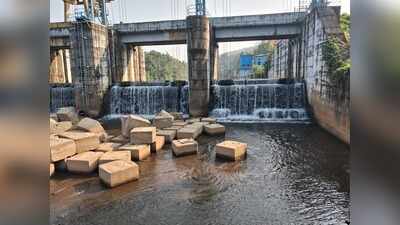
Ponda: Even as Goa’s dam levels dip amid a rainfall deficit, residents of Tiswadi and Ponda talukas have reason to feel reassured. The continued overflow of the Khandepar river from the Opa weir is effectively guaranteeing uninterrupted water supply to both the talukas, including to the state capital.On Saturday, the river level at the Opa barrage stood at 5.1m, above the capped level of 5m. Vishwambhar Bhende, chief engineer at the department of drinking water, said this overflow typically continues until Jan or Feb.“We can expect uninterrupted supply for Ponda and Tiswadi talukas including Panaji,” Bhende told TOI.Sadanand Naik, assistant engineer with the water resources department (WRD), said there is no cause for concern even if the overflow stops.“Once the river levels begin to fall, the WRD gets raw water supply from other sources to rejuvenate the Khandepar river basin at Opa,” Naik said.He added that sufficient rainfall in the Khandepar catchment area could be driving the continued overflow despite a weak monsoon. The Khandepar river originates in the Goa-Karnataka border area.The Opa Waterworks facility — equipped with five water treatment plants (WTPs) — supplies potable water to more than 95% of Ponda, Dharbandora and Tiswadi talukas. Together, the plants draw about 153MLD of water daily from the Khandepar river and supply around 142MLD of treated water to consumers.Naik explained that when levels in the Opa basin drop, the system is supplemented with water from the Selaulim and Ganjem dams. He also pointed to additional infrastructure that supports river recharge: 19 bandharas across the Khandepar and Kalem rivers, along with mining pits in Codli village located on the banks of the Khandepar and its tributaries.An official attached to Opa Waterworks said that although the Opa barrage can hold water up to 5m, the operating level is maintained at up to 4.5m to prevent flooding in surrounding areas, with excess water released through the barrage gates.As part of the backup supply network, the Ganjem bandhara uses two 330 HP pumps to draw 70MLD of water, while Selaulim dam has two 650 HP pumps that together draw 48MLD. The WRD also draws water from the Mhadei river at the Bolcornem bandhara and channels it into the Ganjem river, which flows into the Opa river. Separately, the Selaulim treatment plant releases 48MLD into the Kalem river, which flows down to the Opa water treatment plant.Naik said that when required, water is also released from mining pits in Codli, Dharbandora, to rejuvenate the Khandepar river.PSGMAM