






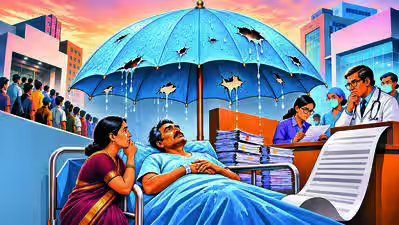
T SundararamanTamil Nadu is now offering families `25 lakh in health insurance. The harder task is ensuring that a patient who carries the card does not leave the hospital without treatment or with a substantial bill for care promised free.Almost no claim under the Chief minister’s comprehensive health insurance scheme exceeds the existing `5 lakh limit. Reimbursement rates are below market prices, and some expensive treatments, including liver, lung and heart transplants or cochlear implants, draw on a separate corpus. Raising the ceiling addresses a limit that almost no claim reaches. It does not address the barriers that prevent patients from receiving cashless care.An analysis of the National Sample Survey’s 80th round, conducted in 2025, shows that in Tamil Nadu’s public hospitals, patients covered by publicly funded insurance spent an average of `4,077 out of pocket, against `4,509 among the uninsured — a reduction of barely 10%. In private hospitals, including for-profit and NGO/trust facilities, insured patients spent `78,883 on average, against `68,096 among the uninsured. That is about 16% more, rather than the cashless care promised. Nationally, spending by the two groups in private hospitals was nearly equal.The govt now plans to launch the Chief minister’s elderly health insurance scheme, a programme that will provide free, cashless medical treatment to nearly 38 lakh residents aged 70 and above, with no income ceiling for eligibility. But it’s value depends on whether patients obtain the benefits they are promised.The first barrier appears before treatment. Some eligible patients cannot obtain state health insurance cards because they lack documents or cannot navigate registration. Poor households, daily wagers and migrants are particularly vulnerable.Public hospitals should provide temporary registration, deliver treatment and complete documentation afterwards. Instead, patients are often asked to obtain cards before procedures such as angioplasty or bypass surgery. Administrative requirements should determine how hospitals receive payment, not whether patients receive care.A card also offers little help when patients do not know which services it covers or which hospital can provide them. An empanelled hospital may lack the specialist or equipment. Patients discover these gaps only after travelling between hospitals or accept the first provider’s terms because they cannot afford further delay.Primary care providers should guide referrals. Help-desks and helplines should identify hospitals with available beds and the capacity to treat the patient. The scheme pays for helpdesks and Arogya Mitras to provide such guidance. Responsibility must remain with providers, rather than fall on sick people trying to interpret a benefits package.Another problem is that while private hospitals accept and enrol for the scheme, they often decline cashless treatment. So, patients end up skipping treatment or paying from their own pockets. Weak enforcement by the govt leaves a gap between advertised access and available care. While hospitals argue that reimbursement rates cannot sustain services, government fears enforcement will drive hospitals out of the scheme.Public hospitals face different pressures. Overcrowding and inadequate budgets force them to ration services through waiting lists, restricted hours and referrals. Judging performance by insurance revenue adds an incentive to prioritise reimbursable patients and procedures. Instructions against denying care compete with financial targets. Reform must address those incentives.Insurance payments have helped public hospitals establish dialysis, cardiac procedures, joint replacements, transplants and advanced cancer care. They also provide flexible funds. Removing this funding without an alternative would damage capacity. The answer is to change how the money flows. Instead of requiring a separate claim for each episode, the state could calculate the value of a hospital’s previous year’s inpatient services at agreed reimbursement rates, add 10% for rising costs and anticipated growth, and release a top-up grant in two instalments. This would retain funding while reducing paperwork and procedural rejections. Independent agencies could audit hospital records rather than scrutinise every claim before payment.Similarly, rural hospitals should not receive less simply because of their location. Equipment, maintenance and specialist staffing do not automatically cost less because they are in hospitals outside cities.Allocations would reflect workload: a crowded hospital treating complex cases should not receive the same amount as a comparable institution with empty beds. The details need careful design, but resources should follow the work hospitals perform. Revisions must be followed by transparent costing and regular adjustments. Hospitals must distinguish an actual loss from revenue they might have earned from a full-paying patient. Treating an additional patient in unused capacity does not cost the same as establishing a new service. Private participation remains necessary. Public capacity cannot meet demand for services such as dialysis, and expanding specialist care takes time. Public-spirited private providers also use the scheme to reach poorer patients.Insurance should purchase that additional capacity, not divert services public hospitals can provide. Not-for-profit providers should receive preference. The principle should be public hospitals first, backed by timely, cashless referrals when they cannot deliver treatment. For patients awaiting cancer treatment or cardiac procedures, delay can defeat the purpose of coverage. Neither retaining the present system nor abandoning publicly funded insurance offers a satisfactory answer. Public hospitals need additional financing, while private providers can fill capacity gaps. Someone must remain accountable for getting the patient treated.The test of TN’s scheme is whether that a person receives treatment needed, in time, without being made to pay for it.— As told to Pushpa Narayan(T Sundararaman is a public health expert who was appointed in the high level committee to look into the functioning of the chief minister’s health insurance scheme)