







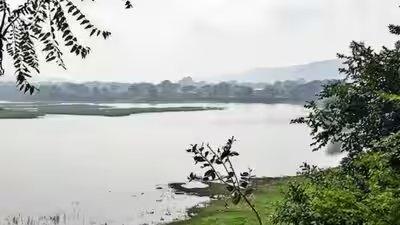
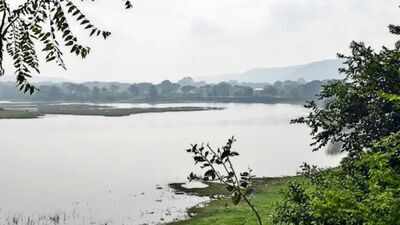
GURGAON: If you’ve promised friends and family a tour of Damdama Lake, better do it soon.The Aravali reservoir in south Gurgaon, a popular weekend destination for Delhiites for decades, has been shrinking steadily and might well have entered its final years. The lake, as it flows today, has lost 95% of its mapped area since 1993, shrinking to 7.9 acres from 153.6 acres 32 years ago. For perspective, that’s a size reduction from 118 football fields to barely six.The shrinkage is a result of both groundwater depletion and destruction of natural rainwater channels. Wrapping around the Sohna Aravalis like an amoeba, the lake is a rain-fed reservoir. Maps show the lake’s current catchment is spread across 24.5 sqkm and the lake itself has splintered, having five ‘sub-basins’ now instead of one composite lake. The lake’s shrinking was mapped by GuruJal, a water conservation initiative working on pond rejuvenation, eco-restoration and water stewardship.A 2025 assessment underlined major changes in the natural drainage network around the lake. The study mapped 22 depressions in the landscape, where rainwater gets collected instead of flowing into the lake.These depressions have been caused by construction and mining activity, with land around the Sohna Aravalis constantly under real estate pressure.GuruJal suggested redesigning the landscape for the lake’s restoration, besides deepening its basin. The catchment that feeds it also needs protection.Over the years, village common land around Damdama Lake has been converted into private holdings and subsequently fragmented into plots. Although parts of the landscape are protected under sections 4 and 5 of Punjab Land Preservation Act (PLPA), which prohibit non-forest activities, parts of the catchment have been encroached on.A 1.5-km road that runs through the area and a culvert have blocked two drainage channels, disrupting one of the main routes through which rainwater reached the lake in recent years. Govt has taken measures like removing encroachments and construction in the catchment but these measures have been insufficient to restore the lake’s water spread.An assessment by TERI School of Advanced Studies in 2023 estimated its water spread at around 7 hectares. The study found borewells in the area that seemed to have been depleting the lake’s groundwater sources. Ten public water-supply borewells were mapped in Damdama, seven in Abheypur and 13 in Kherla. Most of the extraction points in Damdama were within 1 km of the lake.The TERI study recommended regulating groundwater extraction, promoting rainwater harvesting and incorporating hydrological factors like natural drainage patterns, groundwater recharge potential, soil characteristics and rainfall trends into urban planning.For Gajender Bains, a nature lover and long-time visitor, Damdama was once a landscape of interconnected lakes, abundant wildlife and a vast expanse of water. “When I first came to the lake, it was of a size that can’t be described. In fact, it was not just lake but a series of interconnected lakes,” he said. “A landscape with birds and wildlife was what drew me here first.”The waterbody, he added, was so large that an attempt to walk around it had to be abandoned halfway. “My friends and I tried circumnavigating the lake once, and halfway through, we gave up. It was so huge.” Over the years, he has watched the lake shrink. “I have been coming here again and again, but over time, what used to be a huge lake is now a collection of small waterbodies,” he said.A restoration initiative began with a tripartite agreement signed in Dec 2022 between GuruJal, Haryana State CSR Trust and EY Foundation. It was meant to be a four-phase project, with the lake’s restoration planned over four years and a 500-acre biodiversity park developed over 10 years. The proposed park would cover the lake and part of its catchment across Damdama, Abheypur and Kherala villages. The restoration plan included catchment treatment, a 6 km green corridor, 1.5 lakh native trees, recharge measures and desilting. The work was meant to improve water retention in the lake and holistically improve the catchment rather than treating the lake as an isolated water body.However, the proposal still awaits approval from govt since 60% of the lake land falls under the forest department. “It’s on hold at the moment,” said a forest department official.GuruJal co-founder and CEO Shubhi Kesarwani said, “Damdama Lake has a pristine ecosystem, which is crucial to Gurgaon. It is sad to see the biggest freshwater lake in Haryana diminishing year on year. But equally crucial is to address the issue of reverse aquifer recharge scientifically, by bringing together govt and the community. The main factor is the will to restore the lake.”