








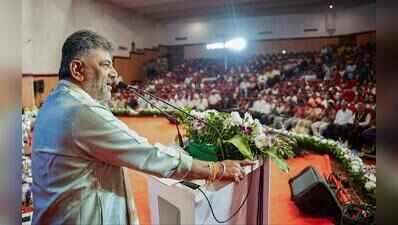
Bengaluru: With parties already gearing up for the 2028 assembly elections, chief minister DK Shivakumar has hinted that the polls may be pushed to 2029, a shift that could hand him an extra 12 months in office.This is because of the Centre’s ‘One Nation, One Election’ (ONOE) proposal. The present assembly was elected in May 2023 and its term ends in May 2028. If state polls are synchronised with the 2029 Lok Sabha elections, the assembly tenure could stretch to between April and June 2029, depending on the final schedule.However, this remains only a possibility rather than a settled arrangement, as the proposed ONOE reform is still under parliamentary scrutiny.Karnataka is among 10 states scheduled to hold assembly elections in 2028. Their tenures could be extended or curtailed under the proposed transition to simultaneous polls. The Centre is examining options to align these states with the 2029 general election.The Joint Parliamentary Committee (JPC) examining the Constitution (129th Amendment) Bill, 2024, has indicated that implementation in 2029 is possible if amendments are cleared by 2028. JPC chairperson PP Chaudhary, who visited Karnataka recently, said in Aug that states could voluntarily agree to hold assembly polls along with Lok Sabha elections, as the Centre cannot direct them to dissolve assemblies. The decision would rest with chief ministers and their councils of ministers. This means Congress govt in Karnataka gets to decide.Shivakumar took over as CM from Siddaramaiah on June 3, 2026, and an extended term could give him more time to consolidate his position, roll out govt programmes and prepare Congress for the next electoral battle.“For Shivakumar, whose elevation followed prolonged negotiations in Congress, the extra time could be significant,” said MB Maramkal, political strategist. “It could also give the party more time to resolve internal squabbles. However, the legislation does not automatically extend every incumbent CM’s tenure. The amendment and the transition mechanism would have to specifically address assemblies whose terms expire before the common electoral cycle.”Some political experts say under the proposed ONOE bill, assemblies constituted after the appointed date would have their terms aligned with Lok Sabha’s cycle. The JPC’s work has met delays: Parliament extended its deadline to the first day of the last week of the 2026 winter session, and a proposed interaction with sitting Supreme Court judges was shelved after objections over separation of powers.The bill needs a two-thirds majority of members present and voting in both Houses, and its passage cannot be taken for granted given the opposition’s concerns about federalism and the autonomy of state legislatures.“Even if the assembly gets an extension, Shivakumar’s continuation as CM would depend on Congress high command and the support of party legislators,” said analyst MN Patil. “A longer innings for him will depend on the final legislation, transition formula adopted by the Centre and, ultimately, Congress central brass’ calculations.”