






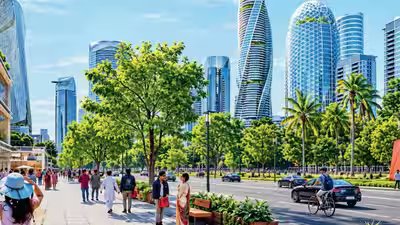
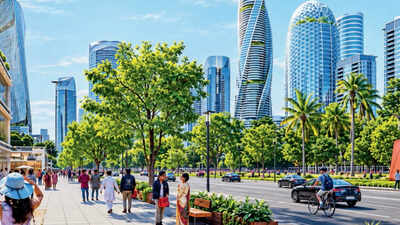
With the master plan for Bharat Future City now ready, the state govt has estimated that nearly Rs 18,000 crore will be required to build the core infrastructure needed for the ambitious project, positioning it as a net zero, integrated smart city designed around the concept of “work, live, learn and play”.Chief minister A Revanth Reddy is expected to unveil the master plan during the Invest Global Summit 2026, scheduled from Dec 7 to 9. Prepared by a consultant, the plan outlines the development strategy for the proposed city, which the state govt describes as a first-of-its-kind integrated smart urban hub.Spread across a 30,000-acre core area covering 765 sq km, the Bharat Future City will accommodate 11 sectors over 13,440 acres. These include life sciences, electronics, data centres, AI city, health city, entertainment and mixed use, sports hub, residential zones, furniture park, EV and energy storage systems, and education.
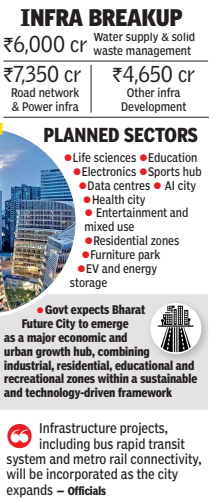
A significant portion of the land earmarked for the project was originally acquired by the previous BRS govt for the Hyderabad Green Pharma City. Of the total allocation, more than 4,000 acres have been reserved for the life sciences sector, while about 2,000 acres each have been earmarked for electronics and advanced manufacturing, and EV-related industries.The state is also placing strong emphasis on attracting data centre investments, with 357 acres set aside for the sector.“We are expecting 15 lakh people to live in the Bharat Future City once it is fully developed,” a senior official of the Future City Metropolitan Authority said.Of the estimated Rs 18,000 crore required for infrastructure creation, around Rs 5,000 crore will be spent on road networks, Rs 6,000 crore on water supply and solid waste management systems, and Rs 2,350 crore on power infrastructure. Sources said about Rs 2,000 crore has already been spent on initial infrastructure works.“Nearly 164 MLD water will be sourced from Yellampally reservoir, which is part of Palamuru Rangareddy project, including 40 MLD from recycled water, with a commitment to zero liquid discharge with rainwater harvesting and reuse systems. Dedicated power substations are being proposed at Meerkhanpet,” sources in TGIIC said.