










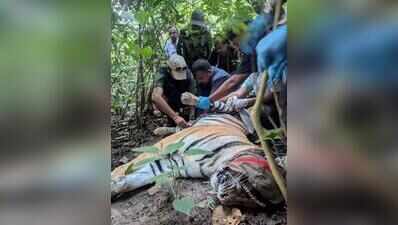
Kolkata: Should Buxa Tiger Reserve (BTR) have an ultrasonography facility to detect pregnancies in relocated tigresses? The proposal was reportedly discussed among officials ahead of a meeting between Bengal forest department officials and the National Tiger Conservation Authority (NTCA) at Buxa on Saturday, where they deliberated on a roadmap for the future of the tiger reintroduction programme.However, experts have said that sonography, while useful for captive animals, may not be a practical option for free-ranging wild tigers. Instead, they have stressed the need for a meticulous, round-the-clock monitoring mechanism to track the animals’ health, behaviour and breeding progress.NTCA had earlier stressed on setting up additional enclosures, reinforcing the existing one and providing adequate training to forest personnel before the next phase of translocation. “There have been several suggestions and proposals. We are looking into them,” an official said.Sources said Bengal foresters had explored the possibility of conducting an ultrasound examination on BTR-TF1, earlier known as T-138, after her capture at Bihar’s Valmiki Tiger Reserve on Sept 29. However, the nearest facility was reportedly at Patna zoo.The tigress was one of three shortlisted for the Buxa project. “The first choice had an injury on her right paw. Another tigress was not being regularly photographed by camera traps, indicating that she could be moving towards Nepal. T-138 was finally selected. We were told that she had not been seen moving with any male and had no history of cattle lifting. The tigress selected first has recently been sighted with cubs at Valmiki,” a source said.Valmiki officials maintained that T-138 had been chosen after a detailed assessment of her age, health, breeding status and behavioural suitability.Former Panna field director R Sreenivasa Murthy, in whose tenure the tiger reintroduction project was taken up there, said the emphasis should be on developing a robust monitoring and reporting system rather than relying on sonography in the wild. Recalling the concerns in Sariska when breeding success did not materialise during the first four years, he said Panna had developed a particularly stringent monitoring and review mechanism.“Under the system, every tiger had three dedicated monitoring teams, each comprising three members, working in eight-hour shifts. Handing over charge to the next team with a signal is mandatory. If for some reason the signal is lost, the team should catch back the signal before handing over duty to the next team. The animals’ location, behaviour, biological parameters, ecological interactions and other observations were recorded every hour,” he added.The system, Murthy said, also involved nightly inspections by range officers, daily reporting through ACFs and DCFs to the field director, and GIS-based analysis of individual tiger movements at the headquarters. Ground teams and officers, from range assistants to DCFs, met every fortnight to review progress and resolve coordination issues.“This allowed us to predict kills, mating activity, injuries and recovery, litter birth dates and even the likely dispersal of male tigers,” Murthy said. Radio-collared animals were also physically observed to assess their health.The argument assumes significance after BTR-TF1’s pregnancy went undetected before her relocation and subsequent stay in Buxa, ending in a miscarriage on Nov 7. Experts believe a robust field-level monitoring system, backed by timely analysis and intervention, is central to ensuring the success of future reintroductions.Staff shortage remains another concern in Buxa, where more than 50% of beat officer posts and over 80% of forest guard posts are vacant.