










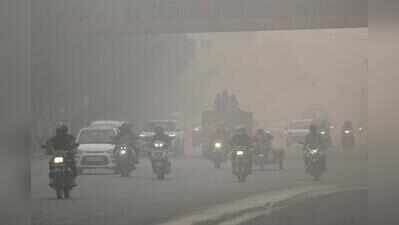
Noida: The city’s air quality returned to the ‘very poor’ category on Thursday, with the city recording an average AQI of 311 at 4 pm under grey skies. Ghaziabad also recorded ‘very poor’ air as its AQI deteriorated from 297 on Wednesday to 338 on Thursday. Greater Noida’s air quality worsened but remained in the “poor” category. Its average AQI was worse than the average recorded a day after Diwali.Out of the 21 continuous ambient air quality monitoring stations (CAAQMS) installed in these cities, five remained non-operational and the average AQI in Noida was based on the readings of five stations, while in Ghaziabad it was based on the readings of seven stations. In Greater Noida also, one out of the five remained non-operational.Of the five monitoring stations, Sector 62 in Noida, which is a major commercial hub with offices of several multinational companies, recorded the poorest air quality with an AQI of 418, qualifying for the ‘severe’ category. Sector 1 remained in the “very poor” category with an AQI of 305, while the remaining three monitoring stations recorded an AQI in the range of 200-300, categorised as “poor”.In Ghaziabad, however, all the monitoring stations recorded an AQI in the “very poor” bracket except for Govindpuram, which had an AQI of 255, qualifying for the ‘poor’ category. After adding the Govindpuram monitoring station in the district in Sept this year, the regional office of UPPCB has also added one more monitoring station in Dasna Dehat, but it has not started feeding data to the CPCB repository continuously yet.In Greater Noida also, UPPCB has added one more monitoring station at Gaur Yamuna City, but it is yet to be functional. Of the four operational monitoring stations, Knowledge City V recorded the worst air quality with an AQI of 320, being the only area in the city to record ‘very poor’ air quality. The remaining three monitoring stations — Knowledge City III, Shiv Nadar University and newly added Ghodi Bachheda — recorded an AQI in the poor category.Wind directions had a role to play in the piling up of polluted air in these cities. On Thursday, northwesterly winds were experienced over Delhi-NCR. Noida and Ghaziabad lie directly downwind of Delhi during westerly flows. As air moves eastward, Delhi’s dense vehicular and urban emissions merge with local industrial and construction dust in Ghaziabad and Noida, frequently pushing their AQI higher than central Delhi.Moreover, the monitoring station at Indirapuram also remained out of operation on Thursday. Sanjay Nagar monitoring station, with an AQI of 373, and Wave City station — overlooking NH24 and a heavy rush of vehicular traffic — recorded an AQI of 364, making them the most polluted pockets of the district.In the morning, the wind speed was recorded in the range of 5-10 kmph and later in the day it picked up pace in the range of 10-15 kmph, which was not sufficient to cause the scrubbing of particulate matter and eventually ended up trapping more and more polluted air than could be evacuated.