








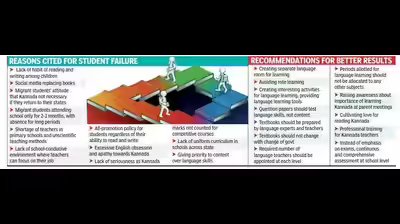
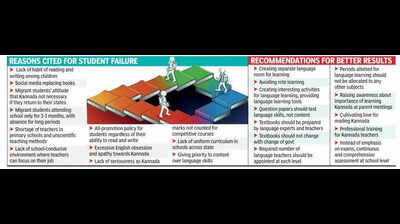
Bengaluru: The number of students who failed in Kannada in SSLC exams rose by 2-3% between 2016 and 2025, notes a report by Kannada Development Authority (KDA) titled, ‘Why do Karnataka children fail in Kannada?’.The report suggests that the current three-language formula should be dropped and a bilingual policy adopted to strengthen Kannada learning and reduce the burden of an unnecessary third language. As per the report, recently submitted to the department of school education and literacy, the number of students failing in Kannada as first language rose from 9.6% to 12.9% in 10 years. In Kannada as second language, the number of failed students increased by 3.3% to become 11.7% in 2025. In Kannada as third language, the pass percentage decreased from 88.1% to 87.8% in this period.The report observes that the number of students who opted for Kannada as third language dropped by 68% in 10 years, while those who chose it as second language increased by 40%. There was a decline in students choosing Kannada as first language, too, from 83.1% in 2016 to 81% in 2025. During this period, the number of students choosing English as first language increased from 10.6% to 14.6%. “The paradox that Kannada as a first language is performing worse than non-native languages suggests fundamental problems in pedagogy, curriculum design or assessment methods that require urgent attention,” the report notes. The team that prepared the report consisted of VP Niranjanaradhya, educationist, along with Kannada teachers from across the state.The failing percentage also varied with social categories and districts. Scheduled Tribes, Scheduled Castes and category 2B students were the worst performers. Coastal and Malnad regions significantly outperformed districts in north Karnataka, pointing to complex interactions of social and economic factors, language teaching, infrastructure quality, language teacher shortages, and historical educational development.The report suggests that Kannada textbooks put emphasis on language development than on cramming content. “There should be activities that complement language skills of children. Textbooks should have simple stories, poetry, dialogue writing and reading, and self-expression. The pictures should be more attractive. Attractive learning materials should be available in the classroom. Language learning skills should be given priority in assessment and not the content. When such opportunities are provided from the primary stage, children cannot fail in Kannada.”It recommends incentives for students who excel in Kannada, such as scholarships, priority in selection for next level of education and preference in govt jobs.