









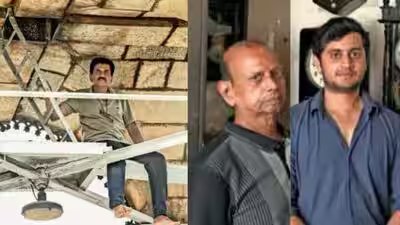
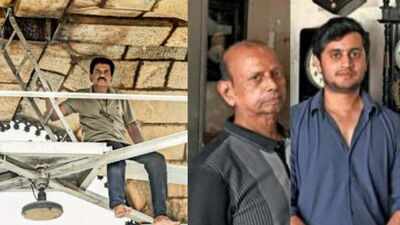
Inside Mysuru’s Dufferin clock tower, horologist Shaik Mahmood had to stand on his toes to repair the clock. Bent over a mechanism that has measured time for generations, the 63-year-old carefully worked on its ageing components, with barely enough space to move his hands. “I had to stand on my toes while working. There was no space to move,” he said.For Mahmood, restoring the historic clock, about to turn 140 years old on Dec 1, was as much about understanding the craftsmanship of its makers as it was about repairing worn-out parts. Some components are no longer manufactured and had to be specially fabricated for the 200 kg clock. Mahmood, who started in mid-July, finished the repair work in the first week of Sept and the clock tower was a major attraction during this Dasara.The restoration has brought the clock back to life but keeping it running is a different challenge. The experience of heritage clock towers across Karnataka shows that the real test begins after the repair work is completed. Especially, as restoration can restart a clock, but only sustained maintenance can keep it running.Clockmaker who got old clock to lifeFor Mahmood, repairing was not merely about replacing a faulty clock component. It involved understanding the engineering and craftsmanship that went into its making. He said the makers of the turret clock, also known as Chikka Gadiyra, had remarkable foresight. “The people who made this clock seem to have designed it with a vision of 500 years. The materials used, including cast iron and brass, are of very high quality,” the horologist said.Inaugurated by Maharaja Chamaraja Wadiyar on Dec 1, 1886, the turret clock tower commemorates the visit of the British Viceroy, Lord Dufferin, to the princely state of Mysuru.Its custodian, Mysuru City Corporation, tasked HMT to restore the clock. “I was approached by HMT officials to restore this clock,” Mahmood explained.Over the years, his reputation has brought him clocks and watches from different parts of India and even abroad. People approach him with old, complicated, and often delicate timepieces that require specialised repair and restoration. A native of Chikkaballapura, Mahmood studied up to PU and developed an interest in clocks and watches at an early age. “My father served in the Indian Air Force. Some of my uncles were involved in the watch and clock business, and I developed an interest in clocks and watches because of them,” he said.After the restoration, the clock requires regular attention as it has to be wound once every four days. Mahmood has trained a local person to carry out this task. However, another iconic Mysuru clock tower, 75-foot-tall Silver Jubilee clock tower, is struggling as its 920kg French-made bell has remained silent for decades due to rusted iron supports and structural wear.Also known as Dodda Gadiyara, it has faced structural concerns, including cracks near the bell arch and upper canopy areas, largely tied to aging construction materials, rusting iron elements, and past vibrations. This tower, built by public contribution in 1927 near the palace, was a display of people’s love and gratitude for Mysore ruler Nalwadi Krishnaraja Wadiyar. “I used to wake up in the morning listening to the chime from the clock when I resided in Agrahara,” recalled nonagenarian Mysuru historian P V Nanjaraj Urs.When clocks stop again after restorationDharwad’s six heritage clock towers, perched atop colleges, a university, a bank, a mutt, the railway station and Dakshina Bharat Hindi Prachar Sabha premises, are now mostly frozen in time.Only the clock at Dharwad railway station is fully operational today. The remaining five have either stopped functioning or are only partially operational.The repeated failures of Karnatak College clock, last restored in Sept 2020, and the west-facing dial at Karnatak University Vidyasoudha last restored in Aug 2021, point to a larger problem: restoration is ineffective without long-term maintenance. Although expert technicians revived these mechanisms, the absence of sustained upkeep has rendered some of the clocks inoperative once again.Karnatak University vice-chancellor AM Khan said the varsity has a workshop where personnel have been trained in maintaining the clocks. “Three of the four clock faces are working, while the fourth is not operational. During restoration, missing gears, counterweights, chains, bushes and other parts had to be specially fabricated or repaired through welding because the original components are no longer manufactured. These challenges have made regular maintenance difficult,” he said.Experts at South Western Railway (SWR) say weather exposure also takes a toll. Heavy monsoon rains, humidity and temperature fluctuations in Dharwad cause rusting of chains and shafts, moisture damage to gears and bushes, and misalignment of moving parts.The university clock, mounted seven storeys above ground, is especially vulnerable.Another major issue is the absence of a dedicated clock caretaker or horologist. After the voluntary restoration by SWR Workshop technicians, maintenance responsibility shifted to the institutions, but no specialised technician seems to have been appointed. Bird infestation, dust accumulation, and possible electrical failures in the automatic winding and chiming system also contribute to the clocks falling silent.Most importantly, restoration received one-time funding, but no regular budget was earmarked for continued maintenance, leaving these iconic heritage timekeepers neglected once again.For now, the survival of these public timekeepers depends less on the age of their mechanisms than on whether someone is responsible for looking after them. Restoration may bring a clock back to life, but only regular maintenance can keep it ticking.A family keeps time in Mangaluru since 1930sMangaluru’s original clock tower was a gift of horologist M Vaman Nayak, proprietor of Vaman Nayak and Sons, to the city. He built a 45-foot-tall clock tower in 1968 by raising funds from businessmen and its clock featured a six-foot-circumference dial.Mangaluru City Corporation demolished the structure in 1994, but the landmark eventually returned to the city. In 2018, Mangaluru Smart City Limited decided to construct a new clock tower at the same location. The new clock tower, 76 feet tall, has analogue clocks, measuring two metres in diameter, on all four sides. The RCC structure has laterite cladding and an 18-metre-high aluminum ladder. The clocks are equipped with proximity sensors and an electronic control system developed by Vaman Nayak’s family business, Nayaks Times.The iconic clock tower is maintained by M Satish Chandra Nayak, 73, and his son M Siddanth Nayak, 32, who runs the family’s clockmaking business, Nayaks Times, in Mangaluru.Maintaining the old tower clock cost the civic body around Rs 3,000 a month in the 1990s. The new clock, however, comes without maintenance costs for the corporation, with Nayaks Times providing a free service, Siddanth said.“The first clock industry was set up by my father, M Vaman Nayak, at Jeppu in the 1930s, and Nayaks Clock Factory was and still is a household name. It was formally inaugurated by the then chief minister of Mysore state S Nijalingappa, on Jan 13, 1957. We are making an honest attempt to revive the old glory and delight of manufacturing and exhibiting world-class clocks,” said Satish Chandra Nayak, a second-generation horologist.Vaman Nayak, who learnt to repair watches in Bombay, returned to Mangaluru and established a manufacturing unit. In the early days, he made one clock a month, recalled his son Satish.For Siddanth, the old clock tower is a reminder of a different era of clock maintenance. The weight-driven mechanism required weekly maintenance, including winding the clock and pulling its weights. Nayaks Times installed 25 tower clocks across Karnataka, including at Mangalore University, Basaveshwara Circle in Koppala, Cubbon Park in Bengaluru, Yelahanka and Ambedkar Stadium in Bengaluru. The company also made six Gandaberunda clocks placed inside Vidhana Soudha in Bengaluru.