











The EB-5 (Employment-Based Fifth Preference) visa applications from Indian nationals have nearly doubled year on year for the first time. They rose from 879 in FY2024 to 1,903 in FY2025, according to United States Citizenship and Immigration Services (USCIS) data. This is the highest number of applicants recorded so far from India.While applications had also increased between 2023 and 2024, immigration experts say the latest surge has raised concerns in the US.They say the spike is not being driven by first-time migrants with a genuine investment purpose, but by Indians already living in the US who are exhausted by years, and in some cases decades, of waiting under employment-based green card categories.
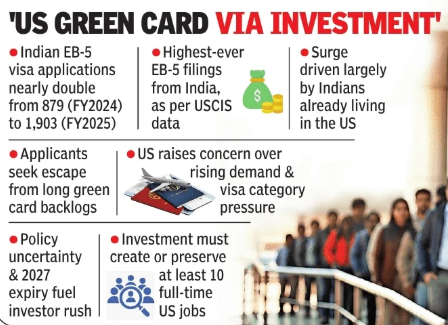
‘Easy alternative’Piyush Gupta of CanAm Enterprises, a multinational investment firm specialising in EB-5, said: “The idea of investing about USD 1 million (approximately 9.4 crore) through EB-5 is seen as an easy alternative to years of uncertainty. Many applicants are professionals who have been in the US for over a decade.What they lack is permanency, and EB-5 addresses that gap directly.”To qualify for EB-5, one must invest $800,000 (7.5 crore) in reserved categories — rural, high-unemployment areas (HUA), and infrastructure — while for projects outside these categories, the amount is $1.05 million.The pattern has become significant enough for USCIS to flag it in its May visa bulletin.“Increased usage by India in EB-5 unreserved visa categories may make it necessary to retrogress or render the category unavailable, to keep usage within maximum allowed under the FY2026 annual limit,” the bulletin stated.The current EB-5 framework is valid only until Sept 2027 unless reauthorised by the Congress. “If not reauthorised, there may be a complete lapse of the visa category,” said Haley Davidson, a US-based immigration analyst.A Hyderabad-based real estate businessman exploring EB-5 route said, “Currently, the ‘unreserved’ category applications filed before May 2022 is being processed. That’s why many of us are considering reserved categories. However, they come with their own set of conditions, which we are still evaluating.”