






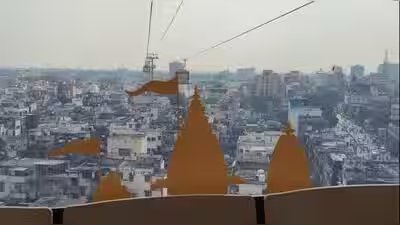
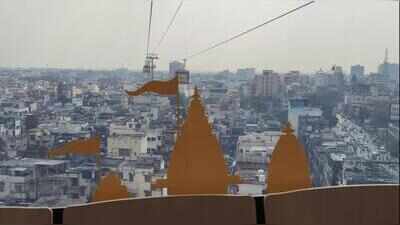
Varanasi: Soon, Varanasi’s traffic-choked roads will no longer be the only way to navigate the city. As the country’s first public transport ropeway nears completion, commuters will be able to soar above the congestion, travelling from Cantt to Godowlia in just 16 minutes. With nearly 95% of the project complete and attention now shifting to trial runs on the Rathyatra-Godowlia stretch, TOI took a ride on Tuesday to experience what promises to be a new chapter in the city’s urban mobility.Connecting Cantt station with Rathyatra and Godowlia, the aerial transit system aims to offer commuters, pilgrims and tourists a faster, cleaner and more reliable travel option. By bypassing some of the city’s most congested stretches, the ropeway is expected to ease pressure on surface transport and transform mobility in one of the world’s oldest living cities.
US Midterm Election Results 2026
After taking a gondola ride ahead of the launch of the ropeway service, TOI sought details about its formal opening. Divisional commissioner S Rajalingam said, “The decision on finalising the date for the formal inauguration is expected in a fortnight. As the ropeway service will start along its full length between Varanasi Cantt and Godowlia stations from the day of its opening, the agency concerned is leaving no stone unturned to complete all basic exercises to operationalise the Rathyatra-Godowlia stretch.”Once operational, it will whisk passengers from Varanasi Junction railway station (Cantt) to the vicinity of Kashi Vishwanath Temple at Godowlia in just 16 minutes for Rs 50 — less than a third of the more than 45 minutes typically required by road. It will offer a faster, greener and more economical alternative to road travel in one of India’s busiest pilgrimage cities.Built at a cost of nearly Rs 800 crore, the state-of-the-art ropeway is expected to begin operations around Dev Deepawali, which falls on Nov 24.The ropeway route begins at Varanasi Junction (Cantt railway station), passes through Kashi Vidyapeeth and Rathyatra, and terminates at Godowlia. Passengers visiting the Kashi Vishwanath Temple can disembark at Godowlia, from where the shrine is barely 700 metres away.For passengers, the gondola ride offers an experience not very different from travelling by metro. Inside the cabins, the sound resembles that of a metro train, particularly when the gondolas resume movement after a halt. As they approach the station platform, passengers may also feel a slight jerk as the cabins descend along the slope before coming to a stop.Such experiences are already part of everyday urban commuting in 25-30 cities across five continents, including Rio de Janeiro (Brazil), Mexico City (Mexico), Toulouse and Brest (France), Bolzano (Italy), Koblenz (Germany), Nizhny Novgorod (Russia), New York City (USA), Istanbul (Turkey), Chongqing (China) and Haifa (Israel). These cities have incorporated urban ropeways into their public transport networks, particularly in hilly or congested urban areas.The project integrates a cable-propelled transport system designed to carry passengers above ground, bypassing traffic and urban obstacles such as congested and heavily crowded roads. It is expected to save both time and money, with fares ranging from Rs 10 to Rs 50.The 3.8-km ropeway line from Varanasi Junction to Godowlia will be covered in 16 minutes. All four stations have world-class facilities modelled on Metro rail stations. With the service available for 16 hours a day, a fleet of 150 gondolas will have the capacity to transport a maximum of 96,000 passengers daily.Box-I: Varanasi Ropeway Urban Transport at a glance– Rs 807 crore project– 3.8 km distance between Varanasi Junction (Cantt railway station) and Godowlia near Kashi Vishwanath Dham– Service will run with four stations between 29 towers– 150 Gondolas with a capacity of transporting 96000 passengers per day– Gondola’s movement speed will be 6 meters/second (max 27 km/hour)– Complete journey from Varanasi Junction to Godowlia will take almost 16 minutes– Ropeway service will be available for 16 hours/dayBox-II: Technology– Ropeway service in Kashi is based on Monocable Detachable tech (MD)– It is consider as one of safest technology in Ropeway transport– Even in case of any problem or technical issue the Gondola will become slow and reach up to next station– If the wind speed crossing limit of 60 kmph, it will stopThe SOP of rescue and safety also remains readyBox-III: Gondolas– Designed by Porsche non-AC Gondolas ventilators on top and bottom keeps passengers comfortable in max 16 minutes travel– Each 10 seater Gondola’s cabin is panoramic and passenger will get bird eye view of city from 12 mt to 50 mt height– Voice (radio) communication to alert passengers about next station like metro trains– Transportation capacity of ropeway service will be of 6000 (both direction)/ hour-– Passenger will get gondola to board at any of four stations on the gap of 2-3 minutes.Box-IV: Stations & Facilities– Ropeway stations have all facilities on the lines of metro rail stations– Stairs, escalators and lifts will keep each station at 11.9 mt height easily accessible for each visitor– Counters for buying tickets physically, scanning QR codes, vending machines– National Common Mobility Cards (NCMC) will also be used– Lower floors will have commercial space preferably for ODOP products stores, locally popular food items– Toilets, baby feeding room and emergency first-aid facilities are also available