









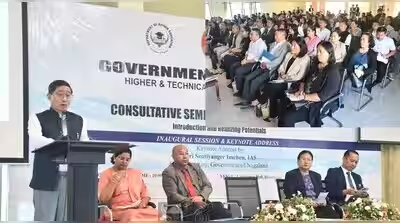

Dimapur: Nagaland chief secretary Sentiyanger Imchen on Friday said the unemployment rate for the 15-59 age group in the state stood at 7.3%, compared to 3.5% at the national level, citing Periodic Labour Force Survey (PLFS), March 2026.Imchen also said youth unemployment among those aged 15-29 stood at 17.5% in Nagaland, compared to 9.9% nationally.Delivering the keynote address at a consultative seminar on “Emerging Trends: Introduction and Realising Potential”, organised by Nagaland higher & technical education department at the conference hall of the information technology & communication department in Kohima, he said the state had long prioritised education, with many parents taking loans to educate their children, largely in hopes of securing govt jobs.He said govt jobs had “become saturated”, pointing to recruitment into state govt services through Nagaland Staff Selection Board and Nagaland Public Service Commission at 845 persons in 2024 and 589 in 2025, underscoring limited govt employment opportunities relative to the job-seeking population.Imchen cited findings from Unemployment, Skill and Migration in Nagaland 2025, saying 92% of residents lacked formal vocational or technical education, while 78% of workers had no prior work experience. He said the data showed a critical gap between academic learning and job-market readiness.On reforms, Imchen said it was encouraging that Nagaland University had initiated steps to incorporate AI components into postgraduate and PhD programmes across several departments, with implementation proposed from the 2026-2027 academic session. He urged private universities, colleges and technical institutes in the state to incorporate emerging disciplines and expand industry-relevant programmes through specialised departments.He said faculty shortages and infrastructure constraints should not become stumbling blocks and suggested faculty-sharing, institutional collaborations, industry partnerships and hybrid learning models to support implementation.Imchen said he hoped the seminar would catalyse a shift in the state’s education system and urged universities, colleges and polytechnics to review existing curricula, introduce future-oriented and industry-aligned programmes and strengthen practical learning, research, innovation and entrepreneurship.