







LUCKNOW: Ghaziabad’s transformation over the past nine years reflects the changing economic and urban geography of Uttar Pradesh. Once viewed largely as an industrial suburb of Delhi, the district is increasingly emerging as an important economic gateway between Uttar Pradesh and the wider National Capital Region (NCR).Better connectivity, expanding mass-transit infrastructure, industrial investment, urban development and stronger integration with neighbouring Delhi and western Uttar Pradesh have steadily altered Ghaziabad’s role in the regional economy.The district’s biggest advantage has always been its strategic location. Situated immediately east of Delhi, Ghaziabad connects the national capital with Meerut, Hapur, western Uttar Pradesh and the broader northern Indian market.Under the Yogi Adityanath government, this locational advantage has increasingly been supported by large-scale infrastructure, with connectivity being treated not merely as a transport issue but as a foundation for investment, employment and urban growth.
Connectivity at the heart of NCR integration
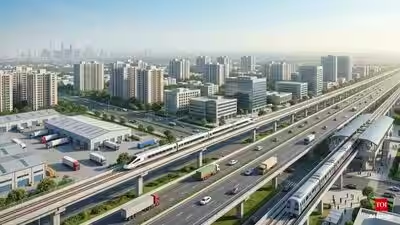
The most visible element of Ghaziabad’s integration with Delhi-NCR has been the expansion of multi-modal connectivity. The Delhi-Ghaziabad-Meerut corridor has brought a new dimension to regional mobility.The Namo Bharat rapid rail service has strengthened the connection between Ghaziabad and Meerut while linking the corridor more closely with Delhi’s transport network.The Delhi-Meerut Expressway has similarly reduced travel time and improved road connectivity between the national capital and western Uttar Pradesh. Together, these projects have helped redefine Ghaziabad from being simply a city adjoining Delhi to becoming an important node in a larger metropolitan transport system.The expansion of the Delhi Metro network has also played a crucial role. Metro connectivity has enabled residents of Ghaziabad to access employment, education, healthcare and commercial opportunities across Delhi-NCR more easily.For businesses, improved mobility has expanded the effective labour market and made the district more attractive for companies seeking proximity to Delhi without necessarily locating within the capital itself.
Namo Bharat and the changing regional economy
The Namo Bharat corridor represents a particularly significant shift in the relationship between Ghaziabad and the NCR. Unlike conventional urban transport systems designed primarily for commuting within a city, rapid regional rail is intended to connect multiple economic centres.For Ghaziabad, this creates opportunities beyond daily commuting. Faster movement of workers, students, entrepreneurs and consumers can encourage businesses to consider locations across the corridor rather than concentrating exclusively in Delhi.The emergence of a Delhi-Ghaziabad-Meerut economic corridor could therefore support more distributed urbanisation and industrial development.Ghaziabad’s strategic position between Delhi and Meerut gives it an important role in this emerging economic geography. As connectivity improves, industrial estates, logistics facilities, housing projects, commercial centres and service-sector activities can increasingly develop around transport nodes.
From traditional industry to a diversified economy
Ghaziabad has historically been one of Uttar Pradesh’s important industrial districts, with engineering, manufacturing, electrical goods, machinery, steel-related industries and other MSMEs forming the backbone of its economy.Its proximity to Delhi has always provided businesses with access to a large consumer market and a sophisticated network of suppliers and services.The transformation underway is about building on this industrial foundation rather than replacing it. Better roads and regional rail connectivity can help manufacturers move raw materials and finished products more efficiently.Improved urban infrastructure can also make industrial locations more attractive to investors.The district is simultaneously witnessing the expansion of logistics, warehousing, real estate, retail, education, healthcare and professional services. This diversification is significant because Delhi-NCR increasingly functions as an integrated economic region in which manufacturing, services and logistics operate across administrative boundaries.
A gateway for investment
The broader investment push in Uttar Pradesh has also benefited districts located close to the NCR. Ghaziabad’s proximity to Delhi, combined with its industrial base and transport connectivity, gives it an advantage in attracting businesses that want access to both the national capital and Uttar Pradesh’s expanding market.The state’s emphasis on improving the investment environment, developing industrial infrastructure and simplifying business processes has strengthened the prospects of established industrial centres.For Ghaziabad, this creates an opportunity to attract new manufacturing units while enabling existing MSMEs to modernise and expand.Ghaziabad district can increasingly serve as a bridge between the mature markets of Delhi-NCR and the emerging industrial and consumption centres of western Uttar Pradesh.
Urban infrastructure keeping pace
Rapid economic integration inevitably creates pressure on urban infrastructure. Ghaziabad’s growing population, expanding residential areas and increasing traffic have made urban infrastructure a critical component of its development strategy.Road widening, improved junctions, drainage, water supply, sewage infrastructure, public transport and urban renewal are therefore not isolated civic interventions. They form part of the larger process of making the city capable of functioning as an integrated NCR urban centre.The challenge is to ensure that transport infrastructure is matched by planned urban development. Transit-oriented growth around major stations, better last-mile connectivity and coordinated development between residential, commercial and industrial areas can help Ghaziabad manage the pressures accompanying rapid urbanisation.
New opportunities for employment
Greater Delhi-NCR integration is also changing the employment landscape. Improved connectivity allows residents to access a wider range of jobs while enabling companies to recruit from a larger pool of workers.For young people, this means opportunities are no longer restricted to jobs located within Ghaziabad itself. At the same time, the expansion of manufacturing, logistics, retail, healthcare, education and services within the district can create employment closer to home.This two-way movement of labour and economic activity is one of the defining characteristics of a mature metropolitan region.
A strategic role in Uttar Pradesh’s growth story
Ghaziabad’s importance extends beyond its own municipal boundaries. It is part of a larger network connecting Delhi with Meerut, Hapur, Bulandshahr and other districts of western Uttar Pradesh.As infrastructure improves across this network, Ghaziabad can function as a crucial interface between the national capital region and the state’s industrial economy.The district’s future therefore lies in leveraging its location rather than merely competing with Delhi. Its strengths—industrial experience, proximity to the national capital, established markets, skilled manpower and rapidly improving connectivity—give it the ingredients to become an increasingly important economic centre in its own right.
From suburb to strategic NCR node
The transformation of Ghaziabad over the last nine years is ultimately a story of changing connectivity and changing economic possibilities. Infrastructure projects have reduced physical distances, while industrial and urban development have expanded the district’s economic role.The Delhi-Ghaziabad-Meerut connectivity network, improved road infrastructure, metro expansion and growing investment ecosystem are collectively pushing Ghaziabad towards a new position in the NCR hierarchy.Ghaziabad, in fact, is no longer simply the eastern extension of Delhi. It is emerging as a strategic gateway between the national capital and Uttar Pradesh—one that combines industrial strength with modern transport infrastructure and expanding urban opportunities.As Delhi-NCR continues to grow beyond its traditional boundaries, Ghaziabad is well placed to become one of the principal engines of that expansion, reinforcing Uttar Pradesh’s position within the wider national capital economic region.