









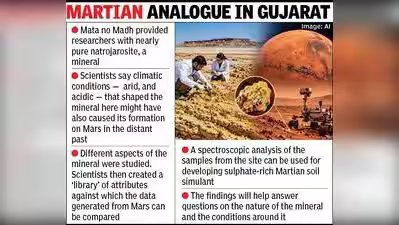
Ahmedabad: Yellowish-brown soil near Mata no Madh in Lakhpat taluka in Kutch, about 80km from Bhuj, may look like any other soil to the untrained eye. But to scientists studying Mars, the Kutch soil offers a mineral similar to one found on the Martian surface.A study by researchers of Physical Research Laboratory (PRL), Ahmedabad, and IIT-Gandhinagar focuses on how the Kutch soil can help analyse mineral-centric remote sensing data from Mars.The study’s authors include Denesh Karunakaran, Neeraj Srivastava, Abhishek Verma, Tvisha Kapadia, and Dhwanil Patel.Dr Srivastava, a PRL scientist and an author of the study, told TOI that the formation at Mata no Madh was selected because nearly pure natrojarosite was found within the basaltic sedimentary layers.“In general parlance, the formation points to an arid, acidic, and water-limited environment of the past,” he said. “Certain climatic conditions may have caused the mineral formation in Kutch.” He said such conditions occurred in Martian geological history too.Researchers said that jarosite has been detected on Mars from orbital and rover-based spectroscopes from multiple regions such as Meridiani Planum, Valles Marineris, Mawrth Vallis, and Gale Crater. “The widespread detection of these hydroxyl-bearing sulphate minerals highlights the possibility that other members of the jarosite-natrojarosite solid-solution series may also contribute to Martian sulphate spectral signatures,” said a researcher.The study, ‘Visible and near-infrared spectrogoniometry of natrojarosite, a Martian analogue from Matanomadh, India’, was recently published in an Elsevier journal, Icarus.Srivastava said that the study uses samples from Kutch as ‘analogues for sulphate-bearing lithology of Mars’, providing groundwork for better spectral identification of natrojarosite based on satellite data from Mars and understanding of earlier environmental conditions on Mars.Researchers said the study’s findings will help accurately interpret Martian orbital and rover-acquired data, not just on mineral composition but also on factors such as grain size, scattering behaviour, and viewing geometry.BOXMartian analogue in Gujarat– Mata no Madh provided researchers with nearly pure natrojarosite, a mineral– Scientists say climatic conditions — arid, and acidic — that shaped the mineral here might have also caused its formation on Mars in the distant past– Different aspects of the mineral were studied. Scientists then created a ‘library’ of attributes against which the data generated from Mars can be compared– A spectroscopic analysis of the samples from the site can be used for developing sulphate-rich Martian soil simulant– The findings will help answer questions on the nature of the mineral and the conditions around it