








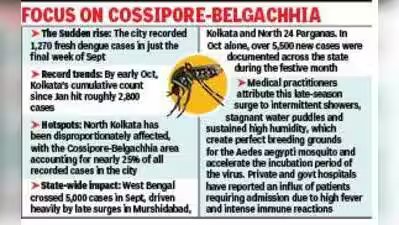
Kolkata: A late-season spurt in dengue cases has taken Kolkata by surprise, with hospitals reporting a sudden surge in dengue patients. While cases remained lower than average during the early monsoon months, numbers began surging significantly from late Sept through Oct. It has now reached a seasonal peak. Over 5,500 new cases were reported in the first 23 days of Oct alone.Kolkata has registered 2,800 cases from Jan 1 through Oct 5, 2026, marking a significant late-season rise, according to health department sources. The city recorded 1,270 fresh dengue cases in just the final week of Sept. By early Oct, Kolkata’s cumulative count since Jan hit roughly 2,800 cases. North Kolkata has been disproportionately affected, with the Cossipore-Belgachhia area accounting for nearly 25% of all recorded cases in the city.West Bengal crossed 5,000 cases in Sept, driven heavily by late surges in Murshidabad, Kolkata and North 24 Parganas. In Oct alone, over 5,500 new cases were documented across the state during the festive month, according to health department sources. While Murshidabad has recorded the highest number of cases, Howrah ranks second, with Kolkata registering the third-highest number of cases so far.A state health department official said Kolkata witnessed about 15% more cases in the week of Durga Puja compared to the number of dengue cases reported from the city in most weeks of the year. “Kolkata is second in the state in terms of total number of cases reported since Jan,” said the official. Murshidabad has reported the most cases.The spike in Howrah during Durga Puja is concerning, he added. “The health minister has convened a meeting on Monday to discuss the situation in Howrah, Murshidabad and other districts that are of concern,” said the official.Charnock Hospital has been receiving an average of 8-10 dengue patients per day over the last one week at its OPD. Ten dengue patients are now admitted, said Charnock Hospital head of emergency Nishant Agarwal. “Some patients experienced critical complications, including sharp platelet drops and haemorrhages, while others had a continuing fever which made admission necessary. All are stable now. High fever, severe body ache and headache have been the most common symptoms so far. We have also received patients with unusual gastrointestinal signs like diarrhea alongside traditional fever,” added Agarwal.Manipal Hospital Dhakuria has been receiving around two patients a day over the last fortnight. “Most are reporting with fever, joint pain, vomiting, rashes and joint pain which are the common symptoms,” said infectious diseases physician Sayan Chakrabarty.At BP Poddar Hospital, some patients were treated for symptoms that are not entirely typical of the classical dengue presentation, said Satyaki Basu, internal medicine consultant. “Some of these symptoms are non-specific and can overlap with other viral illnesses, making clinical assessment important before arriving at a diagnosis. In such cases, we need to look beyond the usual pattern of high fever, severe body ache and headache, and consider dengue testing based on the overall clinical picture and the day of illness. A normal platelet count in the initial phase should also not be taken as a reason to rule out dengue, as platelet levels usually decline after five days from the onset of fever,” added Basu.Over the last one and a half weeks, 80 samples were tested for dengue at BP Poddar, including NS1 antigen and IgG and IgM antibody tests, depending on the clinical presentation and stage of illness. Only one sample tested positive for dengue.More than 5,500 new cases were reported in the first 23 days of Oct alone, including a significant number in Kolkata. The city recorded 1,270 fresh dengue cases in just the final week of September. By early October, Kolkata’s cumulative count since Jan hit roughly 2,800 cases.Kolkata now ranks second among districts in the number of dengue cases, with Murshidabad leading the chart, followed by Howrah and North 24 Parganas, said a Swasthya Bhavan official.North Kolkata has been disproportionately affected, with the Cossipore-Belgachhia area accounting for nearly 25% of all recorded cases in the city. Specific wards in Kolkata Municipal Corporation, Howrah and Bidhannagar have been flagged as active hotspots.One of the reasons for the late surge could be the sudden change in weather from early Oct, said Agarwal. “The sudden, though marginal drop in temperature and the sporadic rain at the beginning of the pujas helped to spread the virus and multiply breeding grounds,” said Agarwal.(With inputs from Subhajoy Roy)