









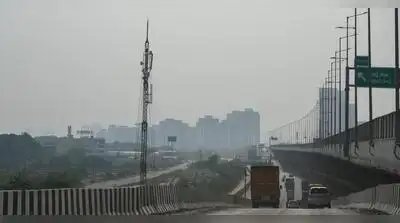
Gurgaon: Rain brought a sharp improvement in Gurgaon’s air quality on Friday, with the air quality index (AQI) dropping to 85 and returning to the ‘satisfactory’ category for the first time in 16 days. The relief, however, comes against a backdrop of rising particulate pollution, with the city recording higher average PM2.5 and PM10 levels in September this year than in the same month last year.The improvement followed rainfall across the district on Thursday, with Sohna receiving the highest rainfall at 46mm, followed by Manesar at 42mm, Pataudi at 21mm, Badshahpur at 20mm and Wazirabad at 16mm, according to the district’s tehsil-wise rainfall report for the 24 hours ending at 8am on Friday. Gurgaon tehsil, Kadipur and Harsaru recorded 5mm each, while Farrukhnagar received 4mm.The AQI stood at 137 on Thursday, down from 145 on Oct 14 and 151 on Oct 13. Friday’s reading, recorded at 2.05pm, marked a 66-point decline from Tuesday’s level. Before this, the last satisfactory AQI reading was recorded on Sept 29, when the index stood at 89, according to Central Pollution Control Board (CPCB) data.The daily improvement comes as the city grapples with a broader rise in particulate pollution. An analysis by the Centre for Research on Energy and Clean Air (CREA) found that Gurgaon’s average PM2.5 concentration increased by about 52%, from 38.81 micrograms per cubic metre in September 2025 to 58.94 micrograms per cubic metre in September 2026. Average PM10 concentration also rose from 86.95 to 106.70 micrograms per cubic metre during the same period.Haryana State Pollution Control Board (HSPCB) officials said dust, along with vehicular emissions, construction activity and open waste burning, contributes significantly to pollution across Delhi-NCR.“Dust is a significant contributor to air pollution across Delhi-NCR, particularly during summer, winter and humid weather conditions. Alongside vehicular emissions, construction sites and open waste burning add to the particulate matter load. Effective dust suppression and regular monitoring are therefore essential to control pollution,” an HSPCB official said.While rainfall can temporarily wash pollutants out of the air, it remains to be seen whether Gurgaon’s AQI will stay in the satisfactory category in the coming days or rise again as conditions change.