








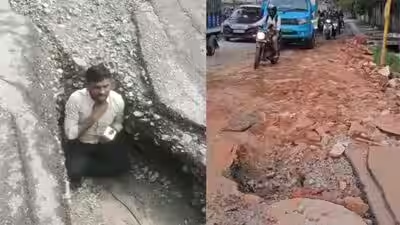
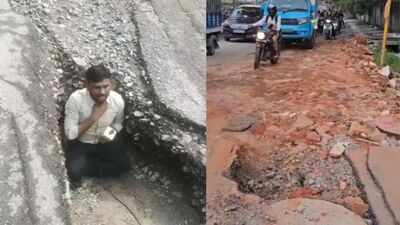
BENGALURU: The videos are hard to watch. Motorists heave and push as their vehicles get trapped in deep pits on Gunjur-Doddakaneli Road, which connects Carmelaram to the city’s tech corridor.Residents have taken to calling the craters “surprise and shocker pits”.On nearby stretches, including Hosa Road, broken surfaces, clouds of dust and open sewage add to the daily ordeal, turning routine commutes into a battle to navigate roads that are barely motorable.What should be a routine 20-minute commute is stretching into an hour-long struggle, with schoolchildren stuck in buses and two-wheeler riders forced to negotiate craters whose depths are difficult to judge.The stretches serve residential neighbourhoods and Bengaluru’s expanding technology belt, where growing traffic is increasingly at odds with the state of the road infrastructure.The monsoon makes the problem more dangerous. Rainwater collects in potholes, concealing their depth, while damaged surfaces turn slushy and slippery.When the weather clears, dust clouds reduce visibility and make travel uncomfortable. For commuters, the choice is between crawling through the damaged stretches, risking a fall or taking a longer route.
When the road itself becomes a hazard
The danger is not merely about lost time or damaged vehicles. Bengaluru has witnessed fatal crashes on roads where poor surfaces have become a source of concern for residents.In August 2026, a 32-year-old woman, Medha Akarsh, died after falling from a two-wheeler on a slushy, damaged stretch of Anantnagar Main Road in Electronics City. She was travelling pillion with a colleague when a car ahead braked suddenly, prompting the rider to apply the brakes.Medha was thrown onto the road and run over by an oncoming mini goods vehicle. Police said preliminary findings pointed to the sudden braking as the immediate cause, while acknowledging that the road was in poor condition.The death renewed residents’ concerns over the safety of badly maintained roads, although the precise role played by the damaged surface in the crash remained a matter for investigation.In September 2025, 20-year-old college student Dhanushree died after being run over by a truck near Budigere Cross. Residents alleged that she had been thrown off her scooter while negotiating a pothole. Police were investigating the circumstances of the accident and had not established whether the pothole contributed to it.These incidents underline the risks faced by two-wheeler users, who have little protection when a sudden manoeuvre, an uneven surface or a slippery patch causes a loss of balance.The problem is not new. Official figures cited in a Times of India report in February 2022 showed that at least 13 people had died in 12 accidents specifically attributed to potholes within the Bruhat Bengaluru Mahanagara Palike (BBMP) limits over five years.Seven of those deaths occurred in 2021 and three in 2020. The figures are historical, but they illustrate how long the city’s pothole problem has remained a road-safety concern.
A citywide problem hiding beneath the numbers
The scale of the challenge is also visible in the civic corporation’s road surveys. An AI-based assessment of 2,493.5km of roads across seven divisions and 72 wards under Bengaluru North City Corporation identified 14,393 potholes. The survey used real-time images captured through dashcams to map road conditions and help prioritise repairs.The assessment classified 1,426.8km of roads as being in good condition and another 607.1km as having minor surface defects. However, it also identified stretches affected by localised road damage, utility-related excavation and unpaved surfaces.Byatarayanapura recorded the highest number of potholes, at 5,964, followed by Sarvagnanagar with 2,359 and Pulikeshi Nagar with 1,357.The corporation said the data would help move road maintenance away from a complaint-driven system towards technology-based planning. But for commuters negotiating the Gunjur-Doddakaneli stretch, the immediate question is simpler: When will the road become motorable?
Temporary fixes, permanent questions
Civic authorities have ordered immediate interventions, including laying gravel on damaged stretches, while white-topping work has begun on Gunjur CDP Road. The measures are intended to provide relief, but residents remain sceptical about whether patchwork repairs can keep pace with the deterioration.The difficulty is that road damage often has several causes. Poor drainage allows rainwater to collect and seep into the road structure; repeated excavation for water, sewage and other utilities can weaken the surface when the road is not properly restored. Heavy traffic then accelerates the damage.A cavity on Kanteerava Studio Main Road recently offered a dramatic illustration of what can happen beneath the surface. After two days of heavy rain, a section of the road gave way, exposing a hollow passage underneath.Water had eroded the soil and road structure as it moved towards a manhole, creating what appeared to be a tunnel beneath the carriageway. Officials began filling the cavity with broken concrete blocks and construction debris as traffic continued to pass the damaged portion.Residents said the stretch between Surana College and Nandini Layout had been deteriorating for years, with utility cuts and inadequate restoration leaving sections vulnerable. Bengaluru West City Corporation commissioner Rajendra KV said funds had been approved for asphalting under the Special Infrastructure Project.The work had been complicated by a proposal from Bengaluru Smart Infrastructure Limited (B-Smile) to take up white-topping, but the commissioner said the civic body would proceed with asphalting instead and take up the work after the rains subsided.
Officials promise action, but commuters want results
The state government has acknowledged the need to address both immediate road damage and longer-term infrastructure gaps. During an inspection of the Sarjapur Road-Dommasandra-Gunjur-Varthur-Balagere corridor on September 30, Greater Bengaluru Development Minister Krishna Byre Gowda directed officials to accelerate road and infrastructure works and provide immediate relief without waiting for larger projects to be completed.He asked officials to prioritise pothole repairs, waterlogging, damaged roadside pits and debris removal, using gravel wherever necessary to make roads motorable. He also called for drainage improvements, junction modifications and coordination among agencies responsible for roads, electricity, water supply and Metro infrastructure.At the Dommasandra Circle-Varthur stretch, Gowda questioned why available road space could not be cleared and made usable while land acquisition issues were being resolved. He also flagged alleged encroachments along the Gunjur-Dommasandra corridor and directed officials to examine transformers obstructing traffic and road development.The instructions reflect the two-track approach required to tackle the problem: immediate repairs to reduce the risks faced by commuters, alongside permanent interventions to prevent the same stretches from deteriorating again.The financial questions remain equally pressing. On September 5, BJP MP Tejasvi Surya sought a white paper on the Rs 5,500 crore the state government had reportedly spent on Bengaluru roadworks and pothole management over three years. Citing the government’s stated expenditure, he questioned why roads continued to be riddled with potholes and demanded a detailed account before further spending.His demand was a political challenge to the government, rather than an independently established finding of financial irregularity.For residents, however, the debate over expenditure and project planning is playing out in a more immediate way: in the time lost on the way to work, school buses crawling through damaged roads, vehicles struggling to escape deep pits and motorists navigating stretches that become slippery after rain and dusty when dry.
The commute that Bengaluru cannot afford to ignore
Bengaluru’s tech corridor has expanded rapidly, drawing workers, students and families into neighbourhoods that depend on road connectivity. Yet the condition of stretches linking these areas to major roads and employment hubs shows how everyday infrastructure can struggle to keep up with urban growth.For a commuter, a pothole is rarely an isolated inconvenience. It can trigger sudden braking, force a vehicle into the path of oncoming traffic, damage tyres and suspension, or cause a rider to lose balance. When several such hazards appear along the same stretch, every kilometre becomes a test of patience and judgement.The immediate need is to make damaged roads safe and passable. The longer-term challenge is to ensure that repairs survive the next spell of rain, that utility agencies restore excavated surfaces properly, and that drainage and road construction are planned together rather than treated as separate problems.