








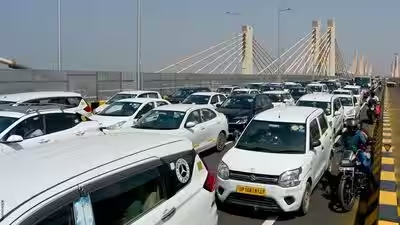
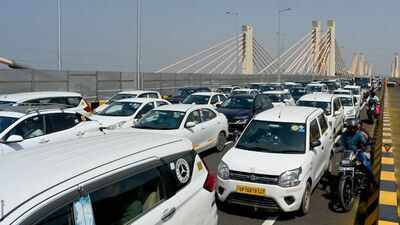
NEW DELHI: Twelve years after work began and barely two days after Barapullah Phase III corridor opened, Delhi is back at the drawing board.The traffic chaos on the new stretch has prompted Delhi Traffic Police to examine not just the freshly inaugurated section but the design of the entire Barapullah corridor.A drone survey and joint meeting with PWD have now put the corridor’s lane configuration, merging points and traffic flow under the scanner.The problem became clear on Wednesday morning. Thousands of motorists followed the new route, expecting the promised 15-minute journey between Mayur Vihar and INA. Instead, many found themselves crawling for two hours or more.The congestion continued Thursday, with some motorists who had used the route a day earlier choosing to stay away, while those who tried it again found themselves in another jam. The frustration soon moved online.
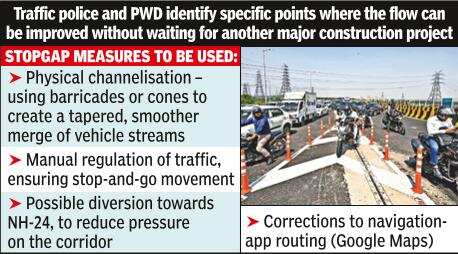
Barapullah fix? Barricades or cones to create tapered, smoother merge
A commuter posted, “The flyover is a total mess. Five-km traffic jam today also. Traffic stuck for hours. God forbid, for emergency someone cannot even take a detour anywhere. This is a PUBLIC HAZARD. Needs to be closed ASAP.”Traffic police’s first finding was the new road was not the whole problem. Some of the trouble was waiting further down. The new corridor has three lanes, but these eventually feed into the two-lane existing Barapullah stretch. That sudden reduction becomes particularly problematic when traffic volumes surge.The exercise has helped officials identify specific points where the flow can be improved without waiting for another major construction project.The survey found a significant mismatch in lane capacity at key merging points, with multiple streams of traffic converging towards the existing Barapullah flyover, which has comparatively less capacity.At key points, more traffic is being funnelled into a road with less capacity. The most significant bottleneck identified so far is near Sarai Kale Khan close to the loop around Sundial Park, where traffic coming from the loop joins the new Barapullah elevated stretch. Instead of traffic gradually blending into the main carriageway, the two streams meet abruptly because of the sharp geometry of the merge.
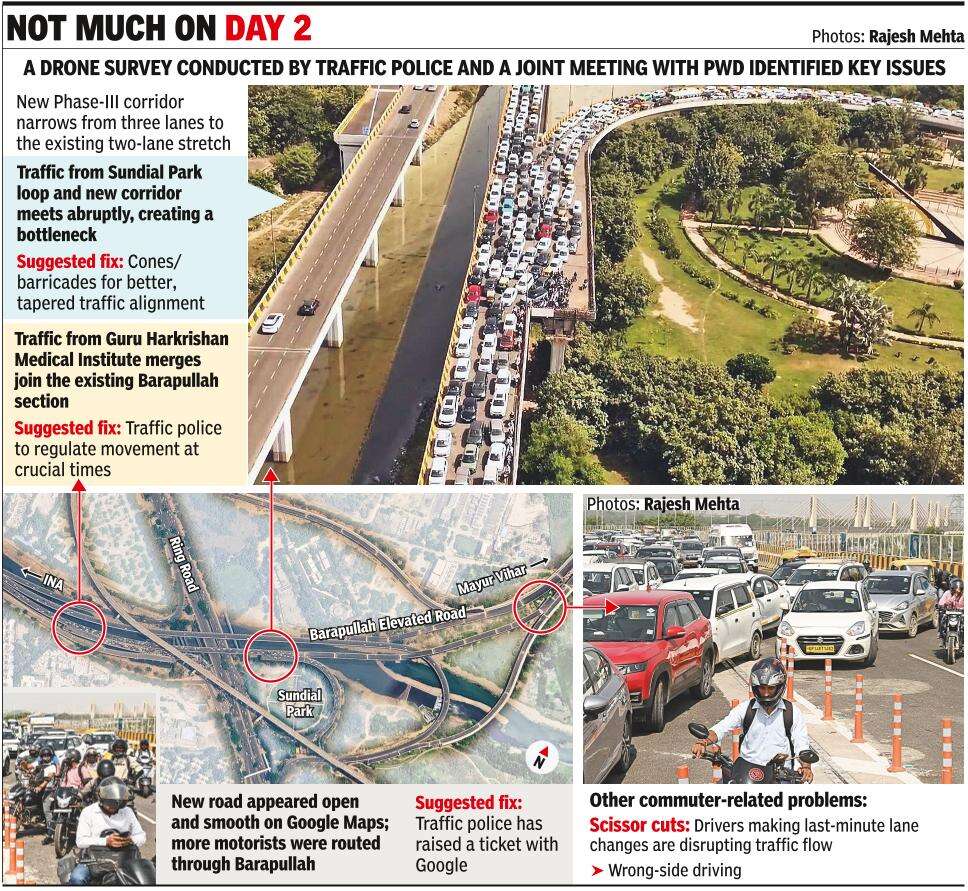
Officials said this creates a bottleneck, particularly when traffic volumes are high. Their immediate solution is decidedly less glamorous than the Rs 1,000-crore-plus infrastructure around it: better channelisation using barricades or cones to create a tapered, smoother merge.Another problem spot has been identified in the older section, where traffic from the Guru Harkrishan Medical Institute side merges with Barapullah. Traffic personnel have been asked to remain deployed at crucial times to regulate vehicles and facilitate stop-and-go movement.Officials are also examining whether traffic can be regulated or diverted towards NH-24 wherever feasible, reducing the pressure on the Barapullah corridor.Then came the digital traffic cop.Google Maps had already decided that Barapullah was the route to take. The newly opened corridor appeared smooth on the app, making it a seemingly shorter and faster option and directing motorists towards it. Traffic police have raised the issue with Google, sources said.According to the sources, Google responded that its real-time traffic system needs a few days of actual traffic data after a new road opens before it can accurately reflect conditions. So, while the road was still learning how to handle Delhi’s traffic, the app was already sending Delhi’s traffic onto it.For now, traffic police and PWD are looking at physical channelisation, manual regulation, possible diversion towards NH-24 and corrections to navigation-app routing.The irony is hard to miss: a 12-year-old project was opened to make commute smoother, and within 48 hours, officials were studying where the road itself needs help.