









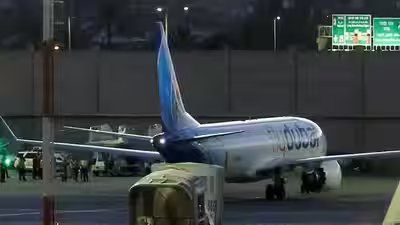
The Omani co-pilot accused of attacking the captain of a Flydubai flight and attempting to take control of the aircraft has been handed over by Saudi Arabia to the United Arab Emirates. Meanwhile, US President Donald Trump also warned that Iran would be hit “very hard” if Tehran was linked to the alleged attemptInvestigation to examine whether the incident was a deliberate attempt to bring down the Israel-bound plane is under way.The aircraft, a Boeing 737 Max 8 carrying 182 people, mostly Israelis, from the United Arab Emirates to Tel Aviv, made an emergency landing in Tabuk, Saudi Arabia, after the co-pilot allegedly stabbed the captain and caused the plane to plunge thousands of feet.Saudi authorities had been conducting the preliminary probe before handing the suspect to the UAE. Israeli intelligence and security officials are also in Saudi Arabia assisting the investigation, while Israel has requested that the co-pilot be sent to Israel for questioning.
Investigators examine possible motives
The UAE has now taken over the investigation. The Emirati government said its team was examining the attack and “whether it was linked to any terrorist purpose”. The UAE has jurisdiction because the aircraft is registered there and its laws apply to crimes committed on board.A regional official said several possibilities remained under investigation, including terrorism and mental disorders.“All possible scenarios, from terrorism to mental disorders, are being looked into. Nothing is ruled out for now,” the official said.The co-pilot has not been publicly identified. Saudi authorities have been working with countries including Israel to establish a motive, with the UAE, the United States and Oman also involved in the investigation.Israeli officials were in Saudi Arabia to help investigate the suspect, and Israel has requested that he be sent to the country for questioning, although it remains unclear whether the request will be granted.The UAE said its investigation would also examine whether the attack was linked to any terrorist purpose.
Israel says co-pilot underwent Islamist indoctrination
Israeli Prime Minister Benjamin Netanyahu said the initial investigation suggested the co-pilot had undergone Islamist indoctrination and may have been trying to crash the aircraft.“The attacker, the co-pilot who attacked the captain, is now being interrogated. What we know so far is that he underwent Islamist radical indoctrination,” Netanyahu told Fox News.Netanyahu also described the struggle inside the cockpit, saying the co-pilot repeatedly called on crew members to kill him.“They had to use earphone cords to tie his hands and then used plastic cuffs. He is lying on the floor and he calls out to the crew ‘kill me, kill me’. So, it is clear that he was suicidal and was going to down the plane,” he said.An Israeli official separately told The Times of Israel that social media material attributed to the co-pilot included posts about killing Jewish people. The official said the material indicated that he had been radicalised into jihadist ideology, while stressing that the formal investigation was still under way.“Our understanding is he’s going to be transferred to the UAE,” the Israeli official said. “We will be part of that investigation.”Netanyahu said the co-pilot appeared to have exploited a loophole in Israeli aviation rules that normally bar pilots from flying to Israel if they are from countries that do not have diplomatic relations with Israel. Oman does not have diplomatic relations with Israel.Netanyahu had also warned in recent days of heightened security threats but told CNN that Israel had received no specific warning related to the flight incident.
US raises possible Iran link
US President Donald Trump has raised the possibility of an Iranian connection to the attack, although he has not provided evidence and said the investigation was still under way.Asked at the White House whether he had been briefed about links between the co-pilot and Tehran, Trump said, “We’re working on it right now.”“I would say the answer, based on what I’m hearing, is yes, but we’re working on it right now,” he said. Trump did not elaborate on why he suspected Iran might be involved.Asked whether the US would retaliate against Tehran if Iran was behind the attack, Trump said, “Oh they’ll be hit, very hard, don’t worry.”“You just ask them,” he added. “They know what happened. They’ll be hit very hard.”Netanyahu, however, said it was too early to establish Iranian involvement.Trump’s comments came as diplomatic efforts to end the seven-month US-Iran war appeared to have stalled.
Passengers got into cockpit to take control of jet
Passengers on the plane have described how the bloodied Indian captain, Smit Machchhar, managed to open the cockpit door after being attacked, allowing passengers to enter and grapple with the co-pilot.The passengers then helped stabilise the aircraft after it went into an extremely steep descent. The manoeuvre was so severe that the aircraft’s rudder was reportedly torn away.“We felt helpless, suspended in midair, and I didn’t know who to turn to. But it was all instinct to survive,” Asaf Rajuan, one of the passengers who intervened, said in a statement shared by the Israeli presidency.The regional official said the suspect, an Omani citizen, was under arrest before being handed over to the UAE. Saudi authorities were working with Israel and other countries to determine his motive.Captain Machchhar, who was widely praised as one of the heroes of the flight, was recovering in Abu Dhabi, the Indian government said Thursday.The weapon used by the co-pilot has not been publicly identified.
Distress codes sent from cockpit
Someone in the cockpit sent two four-digit codes while the plane was flying erratically near the Jordanian border with Saudi Arabia, according to Flightradar24.com.The first code was “7700”, the universal squawk code for an emergency. It was followed by “7500”, which indicates unlawful interference, including a possible hijacking.Such codes can be used by pilots when it is impossible or dangerous to communicate verbally over the radio.Flydubai said the jet was secured by on-duty crew members “who diverted and landed the aircraft safely”. A regional official said those crew members were pilots in training.In the chaos that began about two and a half hours after takeoff, the Boeing 737 Max 8 descended from 33,000 feet to 17,000 feet, or around 10,000 metres to 5,100 metres, in about a minute, before making an erratic circle close to the Jordanian border and landing in Tabuk.The flight was carrying 182 people, most of them Israelis, along with passengers from India and the UAE. The US State Department said four passengers were American citizens.