









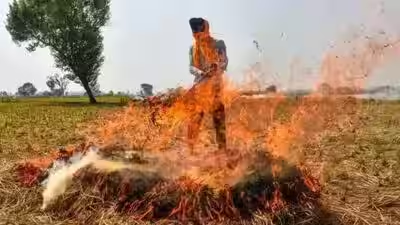
FATEHABAD: In Haryana’s Bhuthan Kalan, once among the state’s biggest hotspots for crop-residue fires, a new stubble economy is beginning to take shape. Balers have reached some small farmers this season, while straw collection businesses are emerging to move paddy residue from fields to industries.At nearby Mohammadpur Rohi, Mahinder Singh has started a straw pickup business, deploying 13 tractors that cover around 30 acres a day. The straw is transported to factories, including bottling, cardboard and dyeing units, where it is used for biomass fuel and other purposes.“There are more than 30 factories in this area that are buying straw bales. I am charging Rs 200 per quintal for paddy straw,” Singh said.
From farm waste to industrial fuel
In Suniyana, farmers Gureninder and Bajinder Singh, who together own 90 acres, have already harvested their first paddy crop. Combine harvesters have cleared the fields and balers are collecting the residue, with the bales stacked for pickup.Singh said he does not charge farmers for removing the straw because he earns by selling it.“I am doing this work for the first time. I am not charging farmers as I am earning from the stubble. I make bales and sell them to companies,” he said.He expects the model to reduce burning across the villages he serves. “There will be no stubble-burning this year in at least 10 villages that I am providing service in,” he said, adding that others had also started similar businesses.Paddy straw is increasingly being used as feedstock in 2G ethanol plants, biomass for biogas units and to make pellets and briquettes for industrial and power-plant fuel. Paper and cardboard manufacturers are also among the buyers.
‘Market is developing, but still informal’
Agriculture official Girish Nagpal said a market was emerging through arrangements between farmers, aggregators and industrial buyers, though the sector remained largely unorganised.“Companies place orders with aggregators, who collect the required quantity from farmers. They tell the aggregator how many thousand tonnes or lakh tonnes they need, and the aggregators get it from farmers,” he said.The state has around 16 lakh hectares under paddy this year, with estimated crop residue of about 80 million tonnes.
9,000 machines ready, but last-mile gap remains
Government data shows around 9,000 additional machines are ready for deployment this season. These include happy seeders, balers, hay rakes, crop reapers and rotary slashers for harvesting, sowing and in-situ residue management.Haryana recorded around 600 farm fires last year, raising hopes that better access to machinery and a functioning residue market could further reduce burning.But for smaller farmers, getting access to machines remains a challenge.“Getting a baler is the problem. It needs lots of connections,” said Amarjeet Singh, who farms 10 acres.With paddy harvesting staggered across the state, machine rentals are currently relatively affordable, he said. “At present, the renting of the machines is less because paddy in most of the fields is yet to mature. The rent is now Rs 700 per acre, but it will go up when every field is yellow.”Farmers expect mid-October, when harvesting peaks, to be the real test of the state’s machinery network.
Small farmers fear peak-season costs
Machine costs could rise to around Rs 2,400 an acre during peak demand, farmers said.Karamveer, who farms four acres in Jind, said many farmers already struggling with crop losses would find it difficult to bear the additional cost.“We have spent a lot on crops and we are at a loss, so we can’t afford to rent machines,” he said, citing higher fertiliser costs and an indifferent monsoon.Balbir Singh, a farmer from Narwana, said private operators often prefer larger farms.“If a farmer has only one or two acres, no one goes to collect it. They say, ‘I have to travel so far; the fuel cost alone will be too high.’ The small farmer suffers the most,” he said.
Govt maps vulnerable farmers
Nagpal said the agriculture department was identifying vulnerable farmers and matching machinery availability with harvesting schedules.“Small and marginal farmers are most vulnerable as they lack resources. Our field staff are locating them to find out when they need the machines,” he said.The department is also tracking staggered harvesting across districts to plan machine deployment.“Which block is harvesting first, which one later, we have a complete calendar,” Nagpal said.
Farm fires down, but no ‘fire-free’ forecast yet
Haryana’s red-zone villages — those reporting the highest number of farm fires — fell from 14 in 2024 to three in 2025. Yellow-zone villages also declined sharply, from 273 to 145.The trend has strengthened hopes that Haryana could eventually move towards a farm-fire-free season. But officials remain cautious.Additional chief secretary (agriculture) Vijayender Kumar said it was too early to predict a zero-fire season.“At the moment, no one can predict if this is the year that Haryana will see no farm fires, because Haryana is a state with lots of farmers and there are several issues involved,” he said.The emerging straw market may offer one route out of the burning cycle, but the bigger test will be whether machines and buyers can reach the smallest farms when the harvest peaks.