







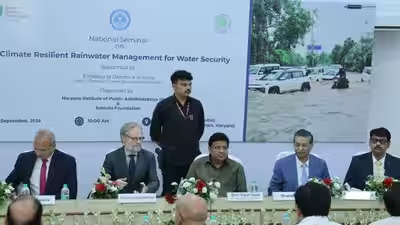
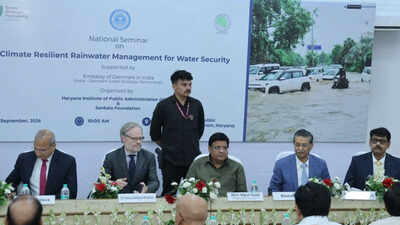
GURGAON: With 159 waterlogging-prone locations identified across Gurgaon, the state government has called for a coordinated plan that goes beyond clearing drains during the monsoon and addresses drainage, groundwater recharge, rainwater harvesting and the city’s natural water systems together.Revenue and disaster management minister Vipul Goyal, speaking at a national seminar on climate-resilient rainwater management in Gurgaon on Monday, said the city’s water-related problems could not be tackled by any single agency or through isolated infrastructure projects.He stressed the need for better coordination among government departments, engineers, experts, industry and local communities to find a permanent solution to waterlogging and improve groundwater recharge.The seminar, organised jointly by the Haryana Institute of Public Administration (HIPA) and Sankala Foundation, comes against the backdrop of repeated episodes of severe waterlogging in Gurgaon during heavy monsoon spells.The discussions focused on moving from a drainage-centric response to a broader urban water-security strategy.Goyal said the city needed an integrated plan taking into account urban development, climate change, drainage infrastructure and natural water systems.The identification of 159 vulnerable locations, he said, underlined the scale of the challenge and the need for agencies to work together rather than address individual trouble spots in isolation.Denmark’s ambassador to India, Rasmus Abildgaard Kristensen, said cities should not look at excess rainwater simply as something to be drained away.Instead, the focus should be on slowing down the flow, storing water, recharging groundwater and reusing it.He cited Copenhagen’s experience after the 2011 cloudburst, when the city adopted blue-green infrastructure and redesigned urban spaces to cope with extreme rainfall.Gurgaon, he said, could similarly combine conventional infrastructure with nature-based solutions.Former National Human Rights Commission secretary general and former CEO and founding mission director of Jal Jeevan Mission, Bharat Lal, stressed that water-management solutions had to be designed around local geography and conditions rather than replicated wholesale from elsewhere.He also underlined the need to link water management with sanitation, hygiene and public health, saying durable change depended on communities participating in solving local problems.Manoj Yadav said the issue was particularly important for Gurgaon given its position as a major centre for IT, software, logistics and automobile industries.Large volumes of rainwater that are not captured or conserved eventually flow away, while the city continues to face water-management challenges, he said.The study and discussions are being supported by the Embassy of Denmark in India under the India-Denmark Green Strategic Partnership. The initiative seeks to develop practical approaches to Gurgaon’s water-security challenges.Experts and officials from the Municipal Corporation of Gurgaon, public health engineering department, IIT Delhi, UNOPS, National Institute of Urban Affairs and other organisations participated in the seminar.