









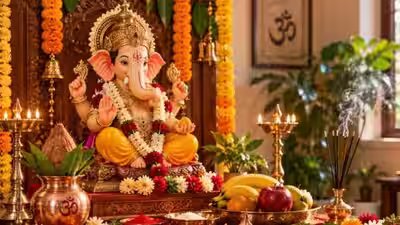
MUMBAI: This Ganeshotsav, some Mumbai priests were not counting prayers but appointments. One packed in 16 households in a single day; another handled 40 assignments with a team of four, while some squeezed ceremonies into 20 minutes to make it to the next home.The festival saw priests juggling packed schedules, multiple households and long hours, with some earning as much as Rs 1 lakh on the day of sthapana.Families, meanwhile, said they struggled to find priests, faced rushed ceremonies or turned to apps and online guidance to perform the rituals themselves.Arvind Tiwari (42), for instance, got into a taxi he had rented for the day at 3am, opened his diary and mapped out a schedule that would take him through 16 clients in and around Malabar Hill and keep him working until 11pm.“I inform them in advance that the puja will be short,” Tiwari said. “Each one takes around 20 to 25 minutes. If I reach a 4pm appointment at 6pm, I accept my mistake politely. I move according to the given time; whether the dakshina is high or low makes no difference.”For priests, Ganeshotsav remains one of the busiest and most lucrative periods of the year. On the day of sthapana, Tiwari said he earned up to Rs 1 lakh, charging between Rs 5,000 and Rs 25,000 per puja, depending on the household.In Goregaon, Umanath Bhatt, who caters to politicians, actors and cricketers, said he survived on around two hours of sleep a night during the festival. Working with a team of four, he handled 40 assignments on the first day alone.“You simply can’t rest. If you rest now, you’ll have to keep resting for the rest of your life,” Bhatt said, adding that his earnings during the season were a “secret” he would not share.Priests used different ways to manage their schedules.While Tiwari capped his pujas at 25 minutes, Prem Shankar Jha (38) allowed 45 minutes for each of his 15 clients in Kharghar, sending an assistant ahead to prepare when schedules became tight.“I have one appointment every hour. If there are two houses nearby, I give the same time to two households. I ask my assistant to go upstairs and start preparing, while I conduct the puja here and then leave,” he said.Even Jha’s system had limits. He missed five households altogether this year, leaving them to perform the rituals themselves.“Between 10am and 1pm, I received so many calls it was almost impossible to hold my phone,” he said.Mulund-based priest Bhavesh Narayan Joshi (50), however, is critical of ceremonies being compressed to 20 minutes.“Whoever gives 20 minutes to a client is 110% wrong,” Joshi said. “If you perform the Panchayatana puja, 15 minutes goes just into that. How can it be done in 20 minutes?”At the same time, Joshi acknowledged the economics of the season, comparing the surge in demand and dakshina to ride-hailing apps. “It is just like booking an Ola or Uber during peak hours. Rates become four times higher.”For families, the rush sometimes meant having to find alternatives or adjust their schedules.Ambernath resident Sulekha Wani (57), whose family has been hosting Ganpati for 25 years, had to find a replacement priest this year after their family pandit could not attend due to ill health. The replacement arrived late, rushed through a 20-minute ceremony while repeatedly checking his phone and refused to perform the concluding aarti, Wani said.“There was no emotion or devotion in it,” she said. “It was just how you visit a clinic and the doctor quickly comes, gives you an injection and moves on.”Wani’s family now plans to book a pandit six months in advance next year or conduct the puja themselves online.Other families are already doing so.Faced with an ageing family priest and difficulty finding a replacement, Ambernath resident Neppolian P Swamy (55) learned to perform the pran pratishtha and sthapana rituals himself. He also pointed to fewer young people from priestly families choosing the profession, with many opting to become doctors, engineers or pursue other careers.“Availability of pandits itself is quite negligible now,” he said. “For 1,000 people there is one doctor, but for 100 pandits, how many pandits are there? One should find out.”Ghatkopar resident Aparna Kumbhare (31) abandoned pandits years ago. Tired of rushed ceremonies tailored to priests’ schedules, her family now relies entirely on a Marathi mobile app for sthapana and visarjan.“Panditjis are not easily available during Ganpati. Even if you find someone at the last moment, they come and do some chanting very quickly because they have to go to 10-15 other places. They don’t work according to our time; we have to work according to their time,” she said.Some families, however, continue to adjust their schedules to retain long-standing relationships with their priests.Chembur-based chartered accountant Shashi Vyas has retained his traditional priest for 20 years. To accommodate the pandit’s 90-minute ritual, Vyas shifted his puja timing.“Earlier, we had a fixed time — 8.30am to 10am. Now he says he will come at 6.30am so that he can finish by 8am and give the 8.30am slot to another family. At the end of the day, it is about understanding and your bond with the pandit,” Vyas said.Once Ganpati festivities end, the number of assignments begins to fall, leaving priests with increasingly uncertain work through the rest of the year.“Sometimes there is less work, sometimes more. If it comes, we keep working; if it doesn’t, we sit at home,” Tiwari said. “To put it in our language, there is no certainty about customers or death. You never know when either will come.”When Jha cannot make it to a client’s home, he instructs devotees to arrange the puja items and guides them through the ritual on a video call.Occasionally, he does not even stop moving to perform the puja.“If I am travelling on a motorcycle, I put on Bluetooth earphones,” Jha said. “I keep reciting the mantras, and they perform the rituals at home. The puja gets completed while I am riding my bike to the next client.”