









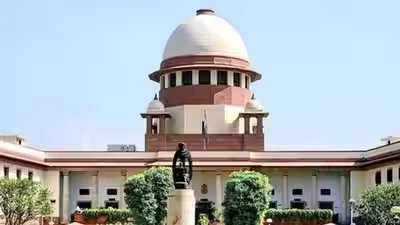

NEW DELHI: The Supreme Court on Thursday laid down safeguards against the immediate arrest of a parent or family member accused under the POCSO Act when the alleged offence involves a child living under the same roof and there is a matrimonial dispute between the child’s parents.A bench of Justices J B Pardiwala and K V Viswanathan, flagging a rise in fakecases, said police should not act in haste in such cases and directed that, as a general rule, an expert in child and adolescent psychiatry or clinical psychology should evaluate the child before authorities decide whether there is sufficient reason to arrest the accused.The court said the safeguards were necessary in cases where allegations may be influenced by a strained relationship between the parents. It stressed that the measures do not dilute the seriousness of offences under the Protection of Children from Sexual Offences (POCSO) Act, but are intended to ensure that the power of arrest is exercised after considering all relevant circumstances.The court said immediate arrest should not take place when two conditions are present: a POCSO offence is alleged against a parent or family member living with the child, and a matrimonial dispute exists between the child’s parents, whether or not the dispute is pending before a court.The police officer receiving the complaint must verify whether such a matrimonial dispute exists, the court said. “When the above-stated threshold conditions are met, post the registration of an FIR, we are of the considered opinion that the investigating officer should not act in haste or take coercive actions in the form of arrest immediately,” the bench added, as quoted by PTI.The verdict came in a matrimonial dispute involving an estranged Bengaluru couple. The wife had alleged that the child was sexually assaulted. The case was investigated by the CBI, which found the allegation to be false. The Supreme Court restored custody of the child to the father, taking into account the welfare of the minor.The court also directed the investigating officer or the Special Juvenile Police Unit to seek the services of an expert in child and adolescent psychiatry or clinical psychology, in consultation with the District Child Protection Unit or, where one is unavailable, the District Legal Services Authority, adding that the expert’s evaluation must be conducted independently and without influence from either the parent or investigating authorities.After receiving the evaluation, investigators must consider the expert’s opinion along with other evidence and circumstances before deciding whether there is “reason to believe” that the accused committed the offence and whether an arrest is warranted. The court said an exception could be made in cases where the material available is “palpable”, allowing the investigating officer to dispense with an expert evaluation, but reasons for doing so must be recorded in writing.The bench also stressed that arrest is not automatically required merely because an offence is cognisable. The court said an arrest can cause “irreparable harm” to an accused parent or family member, particularly where the allegation later turns out to be unfounded.The Supreme Court also raised concerns about the consequences of allegations on children and their relationship with the accused parent.“The trauma that a child is put through in the process and the accusation can damage the very fabric of the parent-child relationship,” the bench said, adding that such a wound could leave an “indelible scar” on both the child and parent.The court also flagged what it described as an increase in false allegations in matrimonial disputes.”What is alarming is that this tendency of making false accusations is on the rise,” it said.The bench cautioned against parents being influenced by advisers during matrimonial disputes, saying that some may be driven by a “win at any cost” approach.
Share your thoughts in the comments
Be respectful · TOI community guidelines
At the same time, the court said the safeguards were not a finding that allegations made in such circumstances are false. Investigating authorities must examine the allegations along with the surrounding circumstances and other evidence.For complaints filed directly before a special court, the Supreme Court said an order taking cognisance and summoning an accused must demonstrate application of mind. The special court should also involve an expert in child and adolescent psychiatry or clinical psychology to evaluate the child and submit a report.