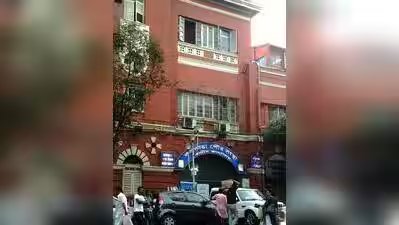







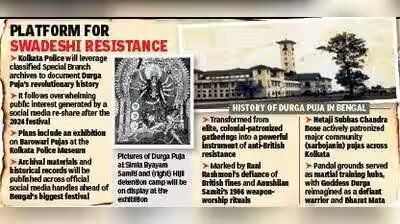
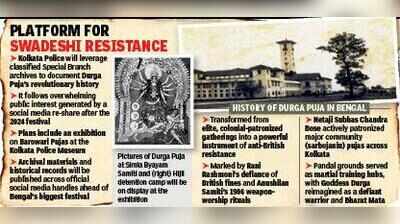
Kolkata: Bengal’s historic resistance to colonial rule gradually transformed Durga Puja from an elite, family-hosted festival into a powerful platform of national resistance, Kolkata Police had claimed, citing excerpts from classified files kept at the Special Branch office. A Kolkata Police Facebook post on the same subject, shared shortly after Durga Puja in 2024, had generated wide curiosity. This Durga Puja, Kolkata Police is planning to use the same Special Branch archives to trace the evolution of Barowari Durga Puja. An exhibition is likely to be held at the Kolkata Police Museum. The city police also plan to share archival material on its social media handles as Bengal prepares for its biggest festival of the year.“Incidents such as Rani Rashmoni defying noise restrictions, weapon worship at the Anushilan Samiti headquarters, and the rise of inclusive sarbojanin pujas transformed the festival into an anti-colonial platform. Under leaders like Netaji Subhas Chandra Bose, who helped organize key community pujas, Durga was reimagined as a defiant warrior and as Bharat Mata. Traditional pandals became centres for Swadeshi mobilization, martial training, and political protest,” a police officer said.According to police documents, British officials initially attended Durga Puja celebrations hosted by Kolkata’s wealthy merchants. Indigo planter John Chips is also said to have established his own puja in Birbhum.However, growing conservative opposition led the colonial administration to formally ban Company officials from taking part in native religious rituals by 1840. Early conflict was seen in the 1830s, when Rani Rashmoni defied a fine imposed by the British authorities over noisy dhaak processions at her Janbazar residence. She reportedly blocked nearby roads until the authorities backed down.As India’s nationalist movement grew stronger, Durga Puja changed from an exclusive family event into a community-funded sarbojanin celebration. In 1906, the secret revolutionary group Anushilan Samiti held a puja where weapons such as swords, knives, and sticks were ritually worshipped. Freedom fighters including Rishi Aurobindo and Bagha Jatin were present.By the 1920s and 1930s, community pujas such as Bagbazar Sarbojanin, Kumortuli Sarbojanin, and Simla Byayam Samity became centres of political expression and martial training. These pujas also received support from Netaji Subhas Chandra Bose.In 1935, at Kumortuli, sculptor Gopeshwar Pal broke with the old ekchala tradition by creating separate idols. He depicted Goddess Durga as a fierce warrior piercing Mahishasura, reflecting the defiant spirit of the time. Around the same period, several puja venues organized Birashtami martial art displays, while pandals across Bengal began portraying Durga as Bharat Mata.“Resistance reached its peak during World War II, when a small puja in Faridpur unveiled an idol showing Mahishasura as a uniformed British officer, with Subhas Chandra Bose in military attire beside the idol. Though the colonial govt quickly cracked down and seized idols, the revolutionary spirit of the festival continued even inside colonial detention centres such as Hijli and Rajshahi Jail. This cemented Durga Puja’s legacy as a cultural pillar of Bengal’s freedom struggle,” an officer said.